Idylle dramatique
✕Idylle dramatique
✕
Today, we are thirsty for a creative, lively and critical conversation with the arts of the past. It sometimes seems to us that Graindelavoix, Irini, Jordi Savall, Zefiro Torna, when they re-read the works of pre-modern times, are doing exactly the same work as we are!
On tired days, the history of music offers itself to us as a theater stage, nothing more than an imaginary space in which sequences are inscribed that are now closed; we retain nothing more than soundscapes ("pre-modern, artisanal, naive, immaculate and homogeneous signifiers of a lost paradise", as Björn Schmelzer writes). But Time can also be seen in its dynamic gush, like a perpetual morning. If Marin Marais’ works remain audible today, if they are still our contemporaries, it is probably because they contained within himself forces that were not limited to the present, but were powerfully tending (perhaps unwittingly) towards future listeners. These forces continue to challenge us.
Who knows if Marin Marais wasn't talking to Burkhard Stangl (Austria, °1960), after all?... And when Stangl "anamorphoses" Marin Marais, it would be a gross understatement to say that he is simply "prolonging" him: it is more a case of time suddenly spiralling out of control, as you listen to their conversation. In the same way that Michel Thévoz argued that Hans Holbein was "inspired" by Picasso and Andy Warhol, we are not far from affirming that Marin Marais was a "plagiarist by anticipation" of Burkhard Stangl!
In this programme, we perform a number of works by Marais (1656-1728) on viola da gamba and electric guitar. Marin Marais was an artistic personality characteristic of his time, who, as a court composer, was always inspired by the taste of his time, le bon goût. After Lully's death, the "musical war" between Italian and French taste inflamed public opinion. The dispute centred on whether the over-representation of affects in Italian music - in Alessandro Stradella, for example, or Alessandro Scarlatti and Arcangelo Corelli - could be transposed to French usage. Important composers such as François Couperin and Marc-Antoine Charpentier experimented with mixing styles. But traditionalists - and Marais was undoubtedly one of them - vehemently rejected this extended harmony, the chromaticism and the coloratura of the Italian style. In 1686, Marais made his debut as a court composer. His opera 'Idylle dramatique' was performed at Versailles and was such a success that the Dauphin asked for it to be replayed. Unfortunately, the score has been lost.
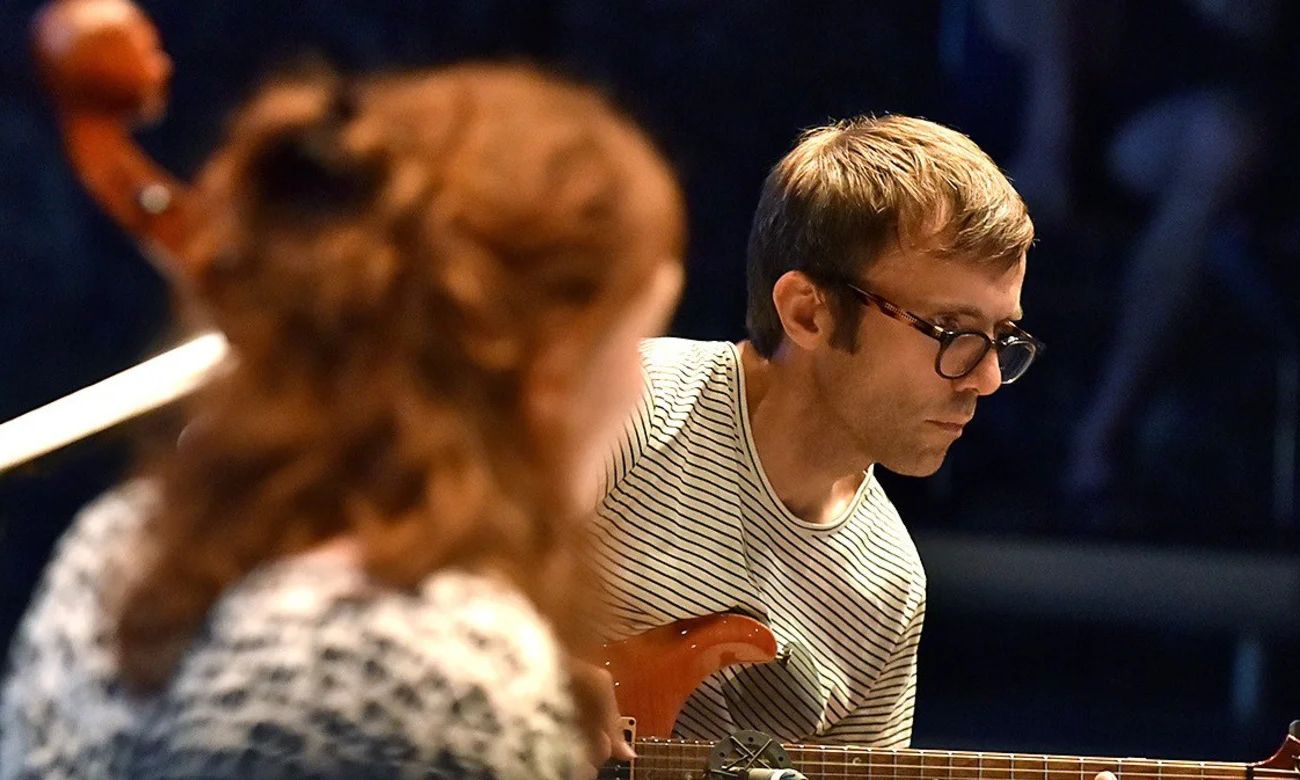
Three and a half centuries later, Burkhard Stangl - one of the most brilliant guitarists, composers and improvisers in the field of experimental and electronic music - has created a subtle commentary on the music of Marin Marais with his version of an Idylle dramatique. The material hasn't changed much, but it's the quality of musical time itself that has: time spinning in on itself, in a very contemporary blend of stasis and sensory hyper-stimulation; one idea chases the other without warning; musical phrases go round in circles or are arranged side by side, deprived of their logical connectors. Everything is recognisable, but at every moment we are taken out of our element.
Treating a contemporary work as a commentary on history is a rather banal gesture. But when the past in turn comments on the contemporary, everything becomes devilishly interesting. It seems that time is cracking, that it is ceasing to be the intractable executioner that horrified Baudelaire, and that it is finally offering us interstices in which to slip through - and reinvent ourselves.
GALLERY