DRUMMING (IN CONCERT)
✕DRUMMING (IN CONCERT)
✕
DRUMMING
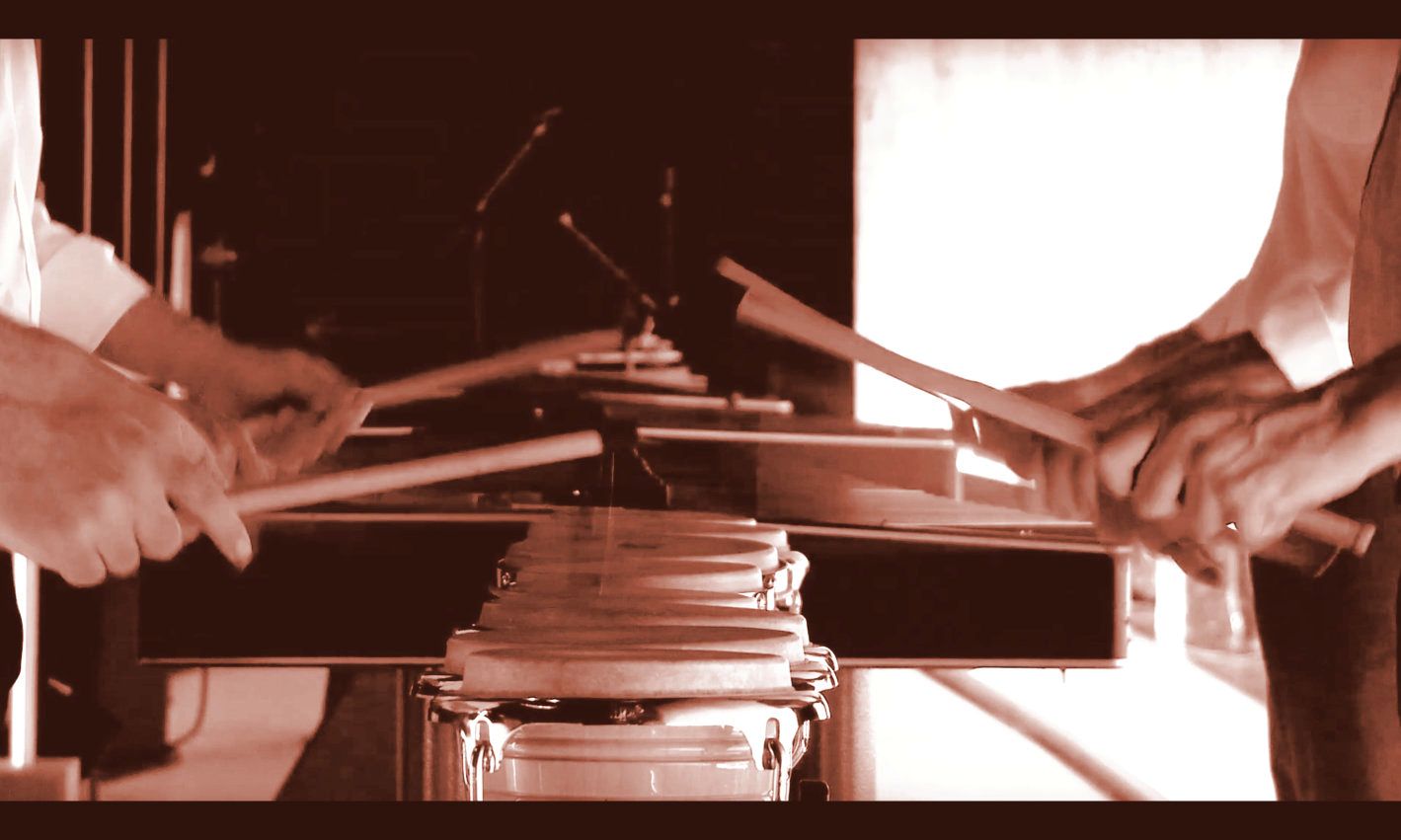
Steve Reich finished Drumming in 1971 after an intensive year of composing that followed his journey to Africa in early 1970. It is a decisive, a conclusive work that sums up the acquired mastery of the composer and yet offers a glimpse of his future orientation. Written after Phase Patterns and Four Organs (both dated 1970), Drumming may be considered the last of Reich’s radical works: with wild exuberance it signals the end of the uncompromising avant-garde era of minimalism.
Through the diversity of its textures, the suppleness of the compositional process, its structurization in four movements, its long dionysian end, Drumming opens the long way that Reich was to follow towards a synthesis between minimalism and the classical heritage - a synthesis that has affirmed itself more and more in his subsequent works: Music for Eighteen Musicians, for example, then Tehillim, followed by City Life... where the harmonic modulationniment, the formal arch-like structures progressively interchange the minimalist experience for rhythmical process.
With Drumming, of course, we have not yet reached this stage. The general outlines of the work still clearly situate it within the series using gradual processes, progressive metamorphosis of an initial musical situation that the listener can follow step by step - as in the very ‘underground’ Pendulum Music of 1968, a work that nowadays one would rather qualify as an installation: two microphones are set in movement perpendicularly between two loudspeakers until they stop swinging, producing a contrapuntal array of feedback effects that constitute the entire musical material. However ıtrue it might be, as Sébastien Jean* notes, that ‘the exclusive and draconian use of the gradual process (phasing out or augmentation) brings about music that neither presents nor raises any challenge, but yields itself to our hearing as a simple object of contemplation’’, the fierce insistence and persistent way of proceeding in Reich’s early pieces precisely prove them challenging and reminiscent of the aesthetics of John Cage: an anti-romantic way of getting rid of every trace of the author’s subjectivity.
Steve Reich, however, has often admitted that he is hardly interested in radicality as such and has, since his first works, been interested in strategies that would prevent the listener from becoming bored. Like all of Reich’s work, Drumming is full of minimal theatrical events, carefully dosed, that dramatize the process without changing the flux. The entry of a new instrument, the range changing, melodic permutations... all of this right up to the end of the fourth movement, followed by the° coda, so characteristic of Reich: the process has been resolved, not a single event will be introduced any more that would disturb the never-ending game of repetition. This is the moment the composer chooses to reintroduce the voices and the piccolo (which the listener may have in the meantime forgotten) in a long stamping crescendo, saturated with high frequencies, which can be compared with the ecstatic impact of the final Alleluia in Tehillim.
In the four sections of the work the following combinations of instruments are used:
I-four pairs of tuned
II-three marimbas, coloured by two female voices
III-three glockenspiel, coloured by one piccolo and whistling
IV-all instruments together
The first and second movement (and the second and third movement) connect flowingly with one another as if interwoven, one group of instruments covering the other in a way quite similar to filtering effects used in electronic music. At the end of the third movement, the notes become more and more sparse, which in turn gives the last movement the ‘classical’ feel of a da capo recapitulation, when the entire group of musicians join in a progressive accumulation of all the material heard so far.
Jean-Luc Plouvier
tag : Percussion
GALLERY