Laborintus II (with Mike Patton)
Laborintus II (with Mike Patton)
Liner notes of our CD "Laborintus II"" with Mike Patton
Overview
Captured on this CD is a remarkable performance of Laborintus II, only the third recording released to the public since it was first performed in 1965. Described as a “music theatre work” by its pioneering composer Luciano Berio (1925-2003), the avant garde piece was commissioned by the national radio agency of France to celebrate the 700-year anniversary of the birth of Dante Alighieri in 1265. Making its world premiere on French radio network ORTF in September 1965, Laborintus II is an edgy audial montage of voices, instrumentation and tape.
Laborintus II was inspired by the writings of Dante scholar Edoardo Sanguineti, who wrote the accompanying libretto. Whereas Berio was renowned for layering sounds and overlapping musical genres in his compositions, Italian poet Sanguineti employed the same patchwork and overlap technique with the words he used, the sources he drew from and the images his writing evoked for Berio’s musical works. Pulling from his original work of poetry Laborintus, published in 1956, Sanguineti also wove in lines from Dante, T.S. Eliot, Ezra Pound, St. Isidore of Seville and the Bible for Laborintus II to highlight the timelessness of love and mourning, usury and revolt, all of which are interlinking themes in this work. In short, Laborintus II is a modern plunge into the layers of hell, specifically the Inferno that Dante immortalized in The Divine Comedy.
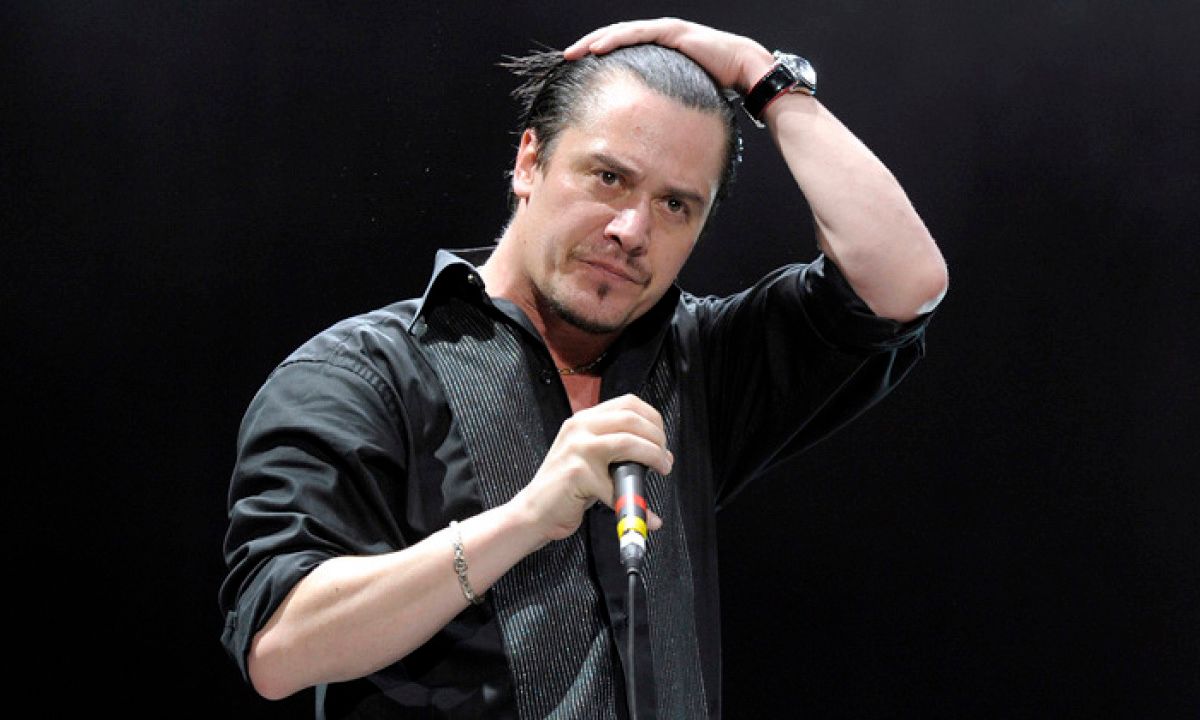
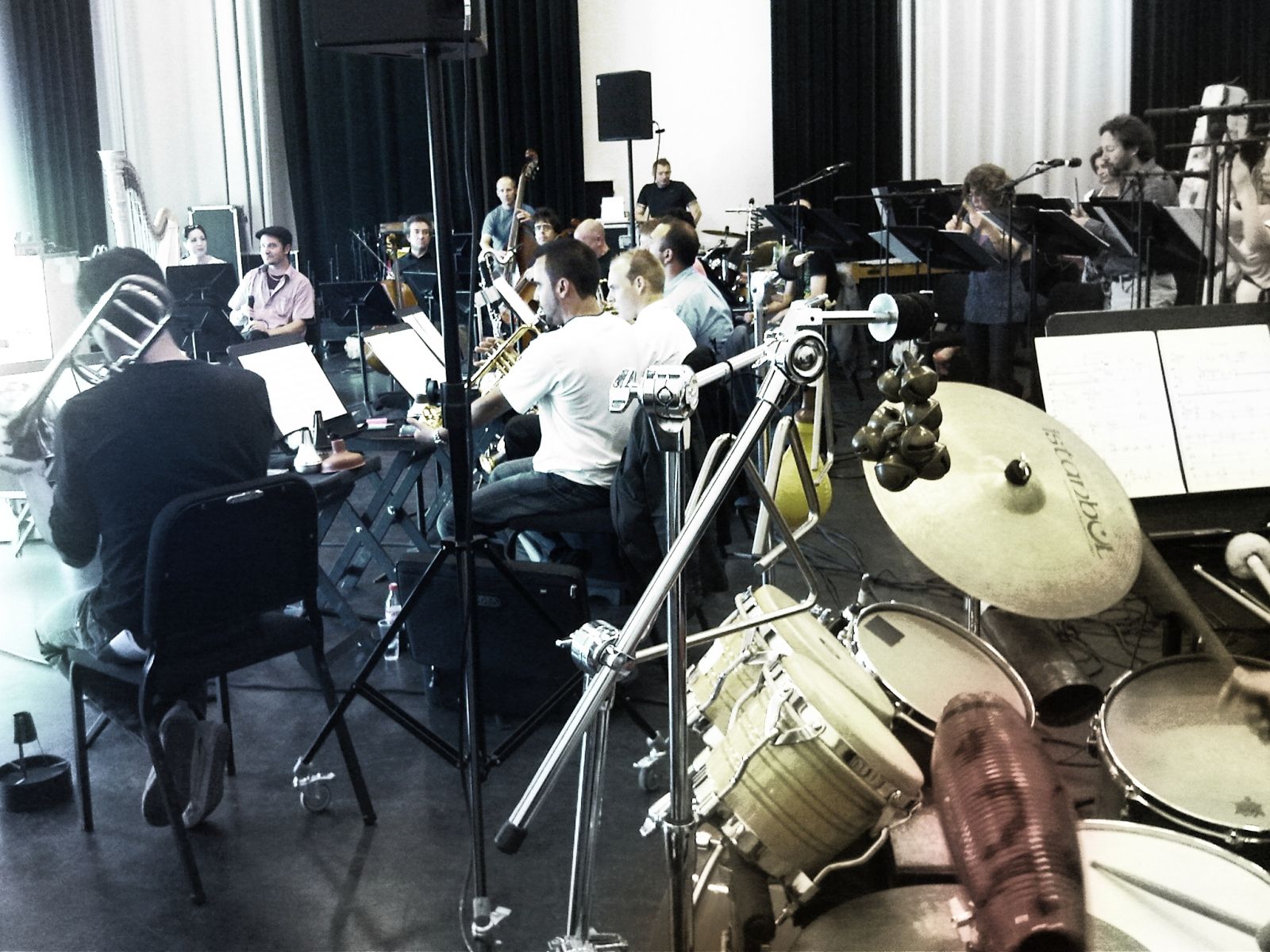
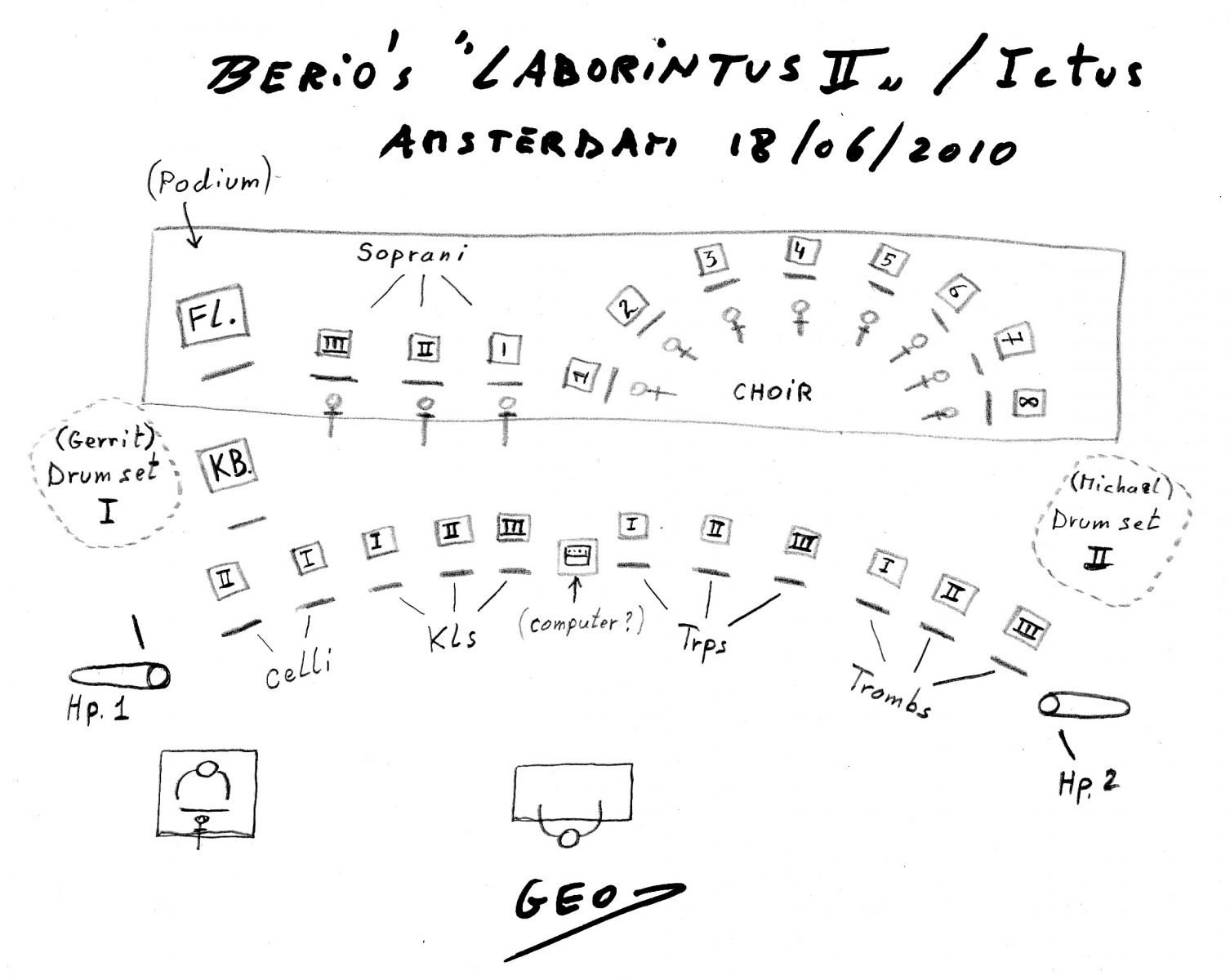
Conducted by Georges-Elie Octors, this live performance of Laborintus at the 2010 Holland Festival in Amsterdam was narrated by another pioneer in experimental music, esteemed vocalist Mike Patton, best known as lead singer of American post-punk band Faith No More. Dutch choir Nederlands Kamerkoor provided the haunting female voices and chorus, while Brussels-based Ictus Ensemble performed the musical accompaniment to this work that is considered one of Berio’s masterpieces as well as the great experimenter’s most unusual creation.
Melissa Rossi
Commentaries
Laborintus II: A Revival
by Lieven Bertels
Throughout his career as composer, conductor, instructor and musical innovator, Luciano Berio had a close relationship with the Holland Festival, both as a performer and a guest who attended many premieres over the festival’s history. At the Dutch premiere of _Laborintus II_ at the 1972 Holland Festival, Berio conducted the piece in the Royal Theatre Carré, where the set included a giant blow-up doll and old car tires. His festival performances also featured a number of selections from his wide-ranging oeuvre, among them _Sequenzas_ and large-scale theatrical productions. The orchestral version of _Rendering_, his composition based on sketches of Schubert’s unfinished _Symphony No. 10_, premiered at the 1989 Holland Festival.
Bringing back _Laborintus II_ to the festival’s 2010 schedule reflected a balancing act between the Holland Festival’s musical past and future. Loyal to the historical context of a repertoire piece from the previous century, we were also aware that this project could (and did) attract a much younger audience, for whom _Laborintus II_ would be a first-time discovery of Berio’s work.
In reintroducing this piece, we added new touches--foremost being the refreshing combination of narrator Mike Patton, regarded as one of the world’s most versatile and astounding vocalists, with the fine vocal filigree of the Nederlands Kamerkoor and the musical volcano that is the Ictus Ensemble. The fact that we can now release this single live recording on CD is testimony to the quality of that memorable concert. This is only the second release of this work since Berio’s original recording forty-six years ago, and its messages reverberate even more clearly in the 21st century, all the more with the myriad of modern talents showcased in this recording.
_Lieven Bertels is artistic coordinator for the Holland Festival, the largest and longest-running annual cultural celebration in the Netherlands. Begun in 1947 and held for ten days every June, the festival attracts many of the world’s most famous performers of music, theatre and dance as well as some of the most outrageous._
Performing with Patton
By Georges-Elie Octors
An artist keenly attuned to the challenges of his time, composer Luciano Berio—as a music professor at Mills College in California and The Juilliard School in New York, as well as founder of a musical “laboratory” in Florence, Italy--offered musicians the opportunity to come into contact with new styles, genres and, above all, different musical activities. He also made an impressive and rarely equaled contribution to the invention of the "open work," giving performers more responsibility and room for interpretation and creativity. In _Laborintus II_, Berio created a magnificent work that was supremely inspiring for participants. He seized upon the most distinctive aspect of the musical approach and invented a "musical language" that nudged musicians, singers and actors towards the fertile pastures of uncharted territories.
Now, nearly 50 years later, the idea of removing barriers between various styles is no longer outrageous: many contemporary musicians have a "natural" flair for the multidisciplinary approach and are perfectly comfortable with the intermingling so characteristic of the early 21
st century. Yet Berio's work is still regarded as meaningful, maybe more so than ever before! His open-minded attitude still prompts us to take a fresh look at his achievements and adapt them to new patterns.
In this performance of _Laborintus II_, the decision to offer the role of narrator to Mike Patton, who hails from a world strongly identified with alternative rock, was an opportunity to stretch the singer’s integrative and metamorphic prowess. In human and artistic terms, my encounter with Mike in the context of this production has been most stimulating. We enjoyed an exemplary form of artistic cooperation, starting from the first rehearsals and discussions about how to interpret the text. The startling range of Patton’s vocal abilities—from mesmerizing whispers to existential screams—added another level of fire and passion to Berio’s work. More recently, Mike's discerning musical insights proved invaluable when he lent his ear to the first mixes of this recording. He offered us the benefits of his experience and advice from start to finish, and added new depth to this work by unleashing the remarkable instrument of his famous “pipes.”
_Georges-Elie Octors is conductor of Brussels-based Ictus Ensemble._
Berio's Laboratory
With his no-holds-barred approach to compositions, Luciano Berio thrilled his generation and he continues to fascinate music aficionados with his innovations in combining the intellectual and lyrical dimensions of sound. That he was so fluent in the subtleties and possibilities inherent in sound should not have been a surprise.
Born in northern Italy, Berio inherited music from his family as a kind of first language. His grandfather wrote polkas, his father was an organist, and the sounds of opera—Verdi to Puccini--filled the house where he grew up along the coast of Liguria.
Traveling abroad, living and teaching in the U.S., partaking in the social revolutions of the 1960s, and delighting in musicfrom Monteverdi to Stravinsky, Gustav Mahler to free jazz to the Grateful Dead, Berio said he was even influenced by Italiantelevision sports pundits with their incorrigibly virtuoso performances. "They spoke at top speed," he noted in an interview with Rossana Dalmonte. "It was difficult to keep up with them but funnily enough they were universally understood. I am a great believer in virtuosity: this involves a change of level, i.e. things being displaced from a run-of-the-mill broadcast, in terms of the transformed expression and the altered perception."
Not content to stay in one category and prone to break rules and mix various genres, the composer became famous for redefining the paths along which contemporary music could travel. Along with Hungarian-born composer György Sándor Ligeti, he was soon regarded as personifying the "caring" side of the avant-garde movement--with musical experiments that elicited joy, and steered cleared of mystical posturing.
He counted among his Italian friends many writers and philosophers, several of whom deeply influenced Berio’s works, which he referred to as his "labyrinthine musical pathways." Author Umberto Eco was theoretician of the "open form" that Berio sometimes adapted in his compositions, while another famous novelist, Italo Calvino, planted the idea and wrote the libretto for his _Un Re in Ascolto,_ Berio’s most famous anti-opera. None, however, played a more important role than acclaimed poet Edoardo Sanguineti (1930-2010), also a man of the theatre, essayist, "fierce communist," and a key partner in a long and painstaking project with Berio that focused on the voice--all voices, lyrical, theatrical, intimate, childish, even sobs and heavy sighs; the two men were fascinated by the whole range of relationships between sound and meaning.
Berio and Sanguineti first joined forces in 1962 when they collaborated on _Passaggio_, which they planned as an "anti-opera." An atheistic and argumentative work, it caused an outcry when it was produced at La Scala in Milan. They joined forces again in 1974 for a purely vocal project, a fragmented lyrical spectacle: _A-Ronne_ for five singers-cum-actors.
In between, however, they worked on the musical project that would be their most applauded joint effort: _Laborintus II_, for which Sanguineti wrote the libretto. Forty-five years after the work was created, it can still be read with the same pleasure.
The highly ambiguous title _Laborintus_ evokes the words "laboratory" and "labyrinth" in both English and Italian. The word "Laborintus" is not a poetic conceit devised by Sanguineti, but a "rediscovered word," conducive to a magnificent misunderstanding. _Laborintus_ was used in the Middle Ages as the Latin equivalent of the Greek _labyrinthos_, and according to its fanciful etymology it breaks down into "labor intus"– meaning "internal labor" or "interior trial." Sanguineti's libretto makes word play of both meanings: it takes the form of a collage of mazelike texts while, simultaneously, launching an internal trial--a journey of initiation based on Dante's works, from which Sanguineti drew for the bulk of his material.
Rather than a linear narrative, _Laborintus II_ taps the veiled memory of the human race. In spite of huge peaks of energy, the production opens and closes in a kind of mind-boggling haze that lends the performance its color. This misty hue guided the rendering of conductor Georges-Elie Octors and the narrative style employed by Mike Patton as well as our subsequent mixing of the recorded performance.
To gain a better appreciation of the effect, we may, if so inclined, take the first image of Dante's _La Vita Nuova_ and superimpose it upon the opening to the first Song of Dante’s Inferno.
_La Vita Nuova_, Dante’s work of his unrequited love for Beatrice, opens with the words, "_In quella parte del libro della mia memoria dinanzi alla quale poco si potrebbe leggere, si trova una rubrica la quale dice, Incipit Vita Nova._" Translated in English as "In that part of the book of my memory before which little can be read, a motto is found which says: Here begins the New Life," this passage signals the start of a spiritual adventure, unfurling its wings only when love is revealed. The first song of _The Inferno_ begins with a more shadowy picture: "_Nel mezzo del cammin di nostra vita mi ritrovai per una selva oscura_" --"In the middle of our road of life I found myself in a dark forest" – an anguished image about setting out to explore the darkness. Memory is depicted here as a huge forest that is also a book into which we delve with a mixture of ecstasy and horror, overwhelmed with conflicting images. Ahead lie encounters with love and death, evil and revulsion and, lastly, music and childhood.
Synopsis
By Jean-Luc Plouvier
0:00: Nature; three beguiling female voices echo in the distance: love calls as in a dream. “Incipit vita nova,” says the narrator—a new life starts here. Vision of courtly love, shining red: Beatrice appears in _La Vita Nuova_. The narrator falls silent. Love inflames the memory. The forest then grows darker, as the passage into it goes deeper. The musicians embark upon a long process of accumulation, revolving around the women’s calls and intermingling vocals. The choir delves into the past of human civilization, returned to its roots. A thousand voices strike up in the midst of a sense of chaos: Enoch, Babylon, Jerusalem—among civilization’s earliest cities—are invoked.
3:57: First appearance of the jazz percussion. All jazz sequences in the piece symbolize unhappiness, evoking "film noir" and a touch of the French 1950’s movie _Ascenseur pour l'Echafaud_. We are now suddenly on the other side, with the choir evoking the forest, black as night, where wild beasts roam. The narrator has seen the loved one, Beatrice, dead. Agonizing pain. Visions.
5:06: Canzonetta drawing its inspiration from Renaissance music. Harmonic frictions, sweet dissonances. Women's voices, harps, flute, trio of trumpets going "wah-wah." The narrator calls for "Sweet, O sweet death," to take him to the other side.
6:58: New reversal: quotation from the final chapter of _La Vita Nuova_. The emergence of a desire felt more keenly than unhappiness: grief brings a poetic foray in its wake. The narrator undertakes to say "what has never been said about any other woman." Visions: God appears in a fire-hued cloud (_una nebula di colore di fuoco_) to offer Dante's heart to Beatrice, so she may eat it. Behold your heart! A mixture of joy and horror. Hosanna.
10:30: The choir returns to the origins for second time. The upsurge of a thousand disorderly voices. Evil emerges in history: a line of descent from Adam to Noah and the Great Flood. Disaster. After the Flood: the malevolent Persian sorcerer Arphaxat, killed by a bolt of lightning, to mystical Zoroaster, who practised the magic arts and built the Tower of Babel, believed a stairway to God, until it fell--a second disaster. Flute solo, second appearance of the jazz percussion.
11:39: First of the three poems written by Sanguineti himself: "tutto tutto tutto," a lengthy rant along the lines of the biblical enumerations delivered in a frenzied style, mixing up history, science and politics. Universal delirium: the brass section seems to be on stilts, the members of the choir emphasise their contribution by pounding on wooden blocks. During this part, narrator Patton screams the words through a megaphone. The sequence concludes on these words (in French and Latin): "_quoi qu’elle fasse elle est désir improportionabiliter excedens_" – courtly love irritated to the point of defeat.
13:14: An agonizingly sweet part with a somewhat insidious cello/flute pairing. The Inferno is near, taking shape in a political form: Dante's plea against usury (with its modern equivalent of the crushing acts of money lenders). Fragments of Ezra Pound build upon the same theme.
15:20: Here we are in the middle of the work, _nel mezzo_. The doors of the Inferno open in a "cloudy valley." Bunches of damned souls appear in tearful disarray. The sequence ends on the most famous words from Dante's _Inferno_: "Abandon all hope" (_Lasciate__ogni speranza_).
17:45: Wildly plunging into the heart of hell with the ironic style of a thriller: Fast, furious, diabolical tempo with big jazz section. Resumption of the themes of Usury ("sin against nature") and Greed: fragments of Ezra Pound read by Sanguineti himself on a tape. At 19:20, brandishing their nasty-looking sticks of wood, the members of the choir raise the tension on the theme of anger – the damned souls tear their bodies to pieces with their teeth.
19:58: Amazing transition (we are precisely at the location of the work’s "golden section"): an unbridled electronic profusion suddenly erupts on the scene, punctuated by thumpingly loud chords on six brass instruments with woodwind, big band-style. Bionic jazz rock. This brings to mind a comment by Varèse, who felt a symphony orchestra was like a "hydropic elephant "--a tad "vapid" compared with a big band, "a tiger." Berio's "crossover" project provokes not only a clash of styles but also a sharing of energies and a cross-contamination of phrasings.
20:39: Shouted out by the choir leader, Sanguineti's second catalogue poem opens with the same words as the first one: "_tutto tutto tutto_"—"everything, everything, everything." It is a modern _Inferno_: wars, prejudices and soft toffees. However, the momentum towards writing that concluded _Vita Nuova_, referred to at 6:58, nonetheless pierces through the unhappiness, in a contemporary version: "speculative grammar" against a backdrop of intricate orgasms (_complicato per godere_). Final words: "in front of silence."
26:42: A furious sound of drumming, change of color: serenity and seriousness. The word "silence" conjures up the word "music." Quotation from Dante's _Convivio_: "Music is all relative" ("_la Musica è tutta relativa_"). Evocation of an engulfed world via the medieval concept of music, an acoustic expression of the right divine relations (and maybe, who knows, a friendly but ironic jab in the ribs of serial music and "good structure," on which Laborintus turns its back). The neo-renaissance canzonetta of "sweet death" is reprised at 28:49.
30:01: Third and final Sanguineti text. The poem conjures up the "mud that is on our backs," hence behind us, after crossing the labyrinth. A final vision, while everything retreats into silence: children sleeping, dreaming during their restless sleep. A mixture of tenderness and alertness, which may be the music itself.
PRESS
Laborintus II (Berio) with Mike Patton
It should still be appreciated for its sonic density, its sustained mood of dread and the universality of its themes, at least one of which--the condemnation of usurers--is painfully relevant today. [The Wire, Sep 2012, p.63]
Laborintus II is a strange and unique creation that despite being far from the days of Mr. Bungle and Faith No More, feels completely and totally Mike Patton.
Sputnikmusic_ Jul 23, 2012, press
GALLERY
CAST & CREDITS
- Audio excerpt HERE, Libretto HERE
- Luciano Berio, Composer
- Edoardo Sanguineti, Libretto
- Georges-Elie Octors, Conductor
- Mike Patton, Narrator
- Annet Lans, Voices
- Margriet Stok, Voices
- Karin van der Poel, Voices
- Klaas Stok, Chorus Master
- Dirk Descheemaeker, Clarinets
- Carlos Galvez, Clarinets
- Dries Tack, Clarinets
- Samia Bousbaïne, Harps
- Jutta Troch, Harps
- Philippe Ranallo, Trumpets
- Michaël Tambour, Trumpets
- Loïc Dumoulin *, Trumpets
- Michel Massot, Trombones
- Nicolas Villers, Trombones
- Geert De Bièvre, Cellos
- François Deppe, Cellos
- Géry Cambier, Double Bass
- Michael Weilacher, Percussion and Drums
- Gerrit Nulens, Percussion and Drums
- Eric Verberdt, Ictus Stage Manager
- Lieven Bertels, Concept and Executive Producer
- Alexandre Fostier
- Jarek Frankowski, Mastering