HERE AND NOW WITH GEORGES-ELIE OCTORS (A tribute concert)
✕
Concert event:
a special reunion with the conductor who co-founded the Ictus ensemble
Like Elvis in 1968 or Gloria Lasso in 1985,
the beloved and Serenissimo Georges-Elie returns to the stage!
This tribute concert is organised in the context of La musique du geste,
an upcoming documentary portrait of Georges-Elie Octors by Isabelle Dumont
with the friendly support of Jorge León and produced by RUBIS Productions.
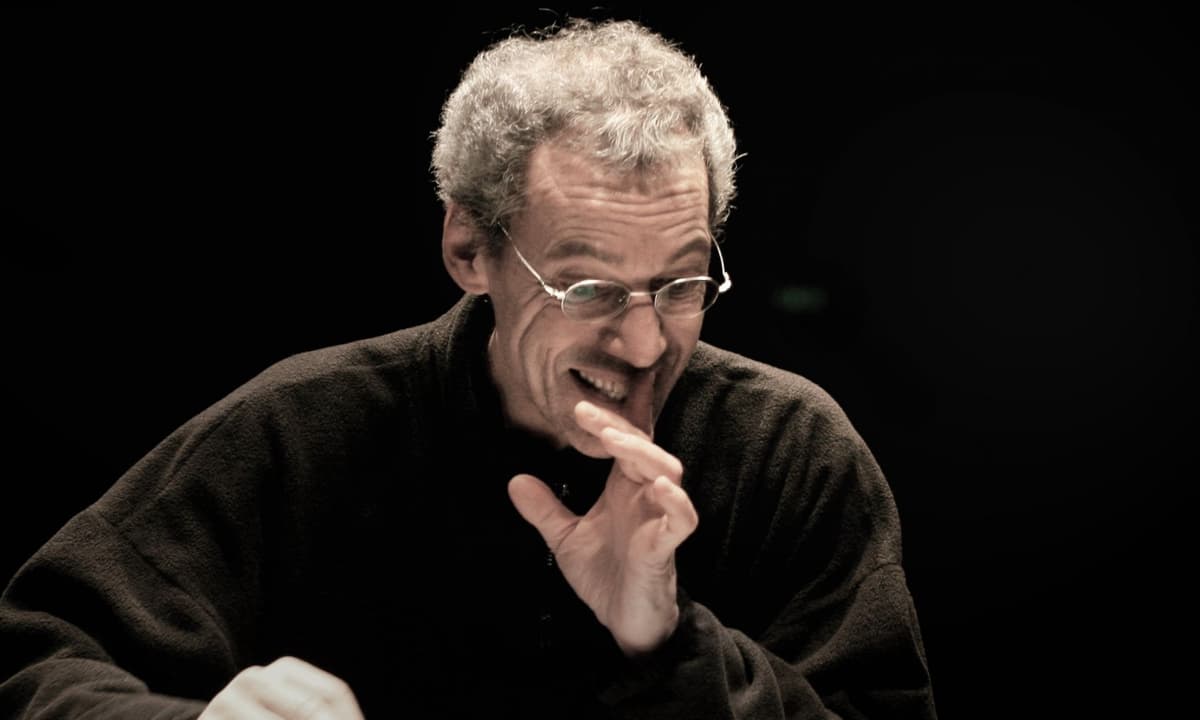
Georges-Elie Octors – known to all the musicians as Géo (pronounced Jay-Oh) – was the musical director of Ictus from 1994 to 2021. During this period, he conducted the vast majority of our concerts. We owe him an enormous debt of gratitude for crafting the ensemble’s unique sound from its first years – more than a sound, in fact, rather a method, a kind of friendship, a way of being together and playing together; a curious blend of obsessive meticulousness and laissez-faire.
To Georges-Elie, rhythm has always been the sole path into the sprawling forest that is music. All paths converge, of course, but for him, rhythm comes first. Don’t forget, after all, that he was also a percussion teacher until his retirement and a formidable virtuoso on the classical timpani. At rehearsals, before talking about anything else – harmony, timbre, phrasing – the ensemble first and foremost had to spend time playing together, really together, deeply immersed in the beat, identifying with and in tune with his gesture. We, the musicians, never tired of contemplating this gesture, the unparallelled elegance with which he would weave musical time. Georges-Elie didn’t make a big deal of it either. He’d developed a way of gesturing without emphasis but rather supple, dance-like, a world away from the ‘contemporary specialist’ conductors prevalent in the 90s, who look stiff as a board beside him.
Never did he say ‘ensemble, please, let’s see… second sixteenth note!’. To him, rhythm isn’t mathematical; it’s a vital leap forward. Whenever we weren’t playing in time, well, it was because his gesture wasn’t clear, or at least that’s what his modesty led him to say. He’d apologise and correct the gesture, repeating it with greater clarity and focus. Or he’d utter some enigmatic phrase that somehow clicked: ‘Just some points in space here!’ or his famous ‘whoever plays last wins!’ (to ensure successful syncopations).
Himself the son of a conductor, Georges-Elie can make a whole table erupt in laughter at dinner by channelling the great leaders of the post-romantic tradition. He knows it all by heart: the hilarious and outrageous stories about these legendary leaders, the machos, the tyrants, the bullies, the spoiled kids. He himself was never like that. For one, he was always simply incapable of getting angry. It may have bothered him a bit during his youth, but after realising how people loved him as he was, he learned to love himself, and everything just worked out.
“It’s good to cross the great water, for there are no obstacles.” So wrote the wise authors of the I Ching, telling us it’s time to grasp our chance. And that is precisely what being a conductor means to Georges-Elie, no more and no less – playing on chance, removing obstacles, smoothing out time, giving others an opportunity to cross the great waters. Because once the rhythm is found, when flowing gesture wins out over stiffness and awkwardness, everything else falls into place: the harmonic backbone falls into place, then the phrasing, then the form. There are no more obstacles, and all are free to contribute their own inventions, suggestions, even their own impertinence. And so the music goes on...
PROGRAMME NOTES
Thierry De Mey: MUSIQUE DE TABLES
To open this concert, we wanted first of all to salute Georges-Elie's unfailing friendship with Thierry De Mey, which undoubtedly grew out of a shared conception of artistic elegance. The right rhythm is first and foremost the right gesture. Good music requires a perfect balance of tact and nervousness: the flair.
Dirk, Géry and Georges-Elie were filmed by Thierry in 1999 in an anthological Musiques de Tables. Since then, the piece has become a “classic of the 20th century”, and has been featured here and there in percussion competitions. But we swear, no one else has taken the strange humor of this piece, still imbued with the Flemish touch of the '80s, so far as our three guys.
Christopher Trapani: WATERLINES
Christopher Trapani’s Waterlines, in the words of Shakespeare’s The Tempest, rescues from a disaster something rich and strange. That disaster was Hurricane Katrina, the costliest storm in American history. Katrina struck Louisiana on 29 August 2005, killing around 1200 people, and afterwards, the damage was exacerbated by the government’s stilted response. More than anything else, the rumours and fake reports from the aftermath of Katrina bear witness to the deep class division of American society.
Trapani, a native of New Orleans, recalled: ‘the fear of losing everything from the concrete to the intangible, from houses and photo albums to cultural traditions.’ As he sifted through vintage recordings of Southern music, recalling the earlier cataclysm of the 1927 Mississippi River Flood, Trapani began to conceive a substantial work solemnizing Katrina and paying tribute to his Southern musical heritage. Trapani draws germs of musical material from the late 1920s and 1930s: recordings by the Carter Family, Kokomo Arnold, Bessie Smith, Ramblin’ Thomas, Charley Patton, and Lonnie Johnson. These old blues and country songs provide lyrics and elements of harmonic, rhythmic, and gestural material.
The two songs we have extracted from the cycle mark a reunion with one of Georges-Elie Octors' most faithful accomplices: soprano Donatienne Michel-Dansac. Donatienne can also be heard in two famous recordings conducted by Octors, which marked the beginning of the 20th century: Avis de Tempête by Georges Aperghis (2004), and An Index of Metals, the last work by Fausto Romitelli (2003).
Morton Feldman: The viola in my life
Morton Feldman has become a household name, around which all generations can agree. His art of the “paradoxical loop”, which captures the memory and gently disorients it - always the Same, never the Same - has never seemed so fresh, so visionary, as in our age of neuro-cognitive studies. From the ensemble's very beginning, thirty years ago, a young pianist and professor of musical analysis by the name of Jean-Luc Fafchamps had succeeded in establishing at Ictus a cult following for the New York composer, even more so than for his accomplice John Cage.
As truculently as Cage, Feldman has nourished musical literature with reflections and aphorisms worthy of Zen Buddhist masters. Modern music, according to Feldman, meant nothing other than the emancipation of sound for itself. It's your Beethoven who's intellectual, he said, with all those useless operations he applies to his motifs! With Feldman, it's Georges-Elie's Taoist side that we want to highlight. Music can't be “conducted” - how vain! You just have to learn to let it go.
Georges Aperghis: Les Sept Crimes de l'Amour (The Seven Crimes of Love)
This piece is typical of Georges Aperghis' style in the late 70s.
In 1979, the ATEM (Atelier Théâtre Musique) that Aperghis had founded with Edith Scob, Jean-Pierre Drouet and Michael Lonsdale was in full swing. During this particular period, work after work, Aperghis explored in music all the registers of familiar strangeness: the weirdness that consists in being human, the astonishment that comes to us from speech, the monstrosity of the musician's body flanked by its prostheses.
It's true that Les sept crimes is a chamber piece performed without Georges-Elie, but it seemed to us that throwing such a party without inviting Aperghis' music would be like organizing a christening without inviting all the fairies: it would bring us great misfortune! The friendship between the two men is worthy of an entire book. Beyond the strictly human factors, let's note a certainty they shared and which always connected them - a certainty that Boulez would not have denied: a real delirium, it requires a lot, a lot of work.
Gérard Grisey: Vortex Temporum III
... and to close the concert, it's once again a question of friendship: the lovely blend of tenderness and professional respect that has bound Georges-Elie Octors and Anne Teresa De Keersmaeker together for thirty years. How many times have we performed Vortex Temporum with our friends from Rosas, in theatres in the evening, or in museums at all hours of the day? Hundreds.
Gérard Grisey, Kaaija Saariaho, Magnus Lindberg and Fausto Romitelli, four composers whom Georges-Elie conducted enormously, represented so many facets of the so-called “spectral” aesthetic, whose development was perfectly contemporary with his career as a conductor. The word “spectralism” has come to designate a holistic approach to musical phenomena, expressed by the metaphor of “zooming” into sound, as well as a retro-feedback of electronic music practices on instrumental practice. Whatever his instrument, the contemporary musician has expanded his lexicon and now thinks in terms of “filtering”, “spectrum sweep” and “frequency modulation”. With its pseudo-electronic harmony, hypnotic loops and simultaneous tempos knotted into a braid, Vortex blows a stormy wind in the whitish light of the Cosmos' birth.
“Musical art is violent art par excellence. It allows us to perceive what Proust called a little time in its purest state”, wrote Gérard Grisey. It's these bursts of violence that we wanted to hear at the end of this evening. Whatever we may have written earlier, when we spoke of Georges-Elie Octors in terms of elegance, humour or precision, we could not close this golden book without evoking the bravery of a very romantic heart, who willingly pushed his friends to all extremes! But for reasons of modesty, we'll be talking about it in the bar after the concert, off the record | We look forward to seeing you there! Have a great evening!
Jean-Luc Plouvier
proofread by Tom Pauwels
GALLERY
CAST & CREDITS
WORKS
- Géry Cambier, double bass
- Anita Cappuccinelli, technical direction
- Filipa Cardoso, camera
- Tom De Cock, percussion
- Geert De Bièvre, cello
- François Deppe, sound assistant
- Dirk Descheemaeker, clarinets
- Chryssi Dimitriou, flute
- Isabelle Dumont
- Jean-Luc Fafchamps, piano
- Alexandre Fostier, sound
- Victor Guaita, viola
- Quentin Jacques, sound (film)
- Jorge León, chief operator
- Hilde Maes, business coordinator
- Laure Massiet, camera assistant
- Gerrit Nulens, percussion
- Georges-Elie Octors, conductor
- Maris Pajuste, voice
- Tom Pauwels, guitar
- Jean-Luc Plouvier, piano
- Philippe Ranallo, trumpet
- Thomas Schira, camera
- Igor Semenoff, violin
- George Stevens, all areas intern
- Martijn Susla, clarinet
- Nicolas Van Achter, camera
- >PROGRAMME NOTES
Thierry De Mey: Musique de tables
for three percussionists
Christopher Trapani: Waterlines,
Five Songs about Storms and Floods,
Songs 1 & 3
for voice and ensemble
Morton Feldman: The viola in my life I
for viola and five instruments
Georges Aperghis : Les sept crimes de l’amour
for voice, clarinet and percussion
Gérard Grisey: Vortex Temporum, 3rd movement
for piano and five instruments