Professor Bad Trip
Professor Bad Trip
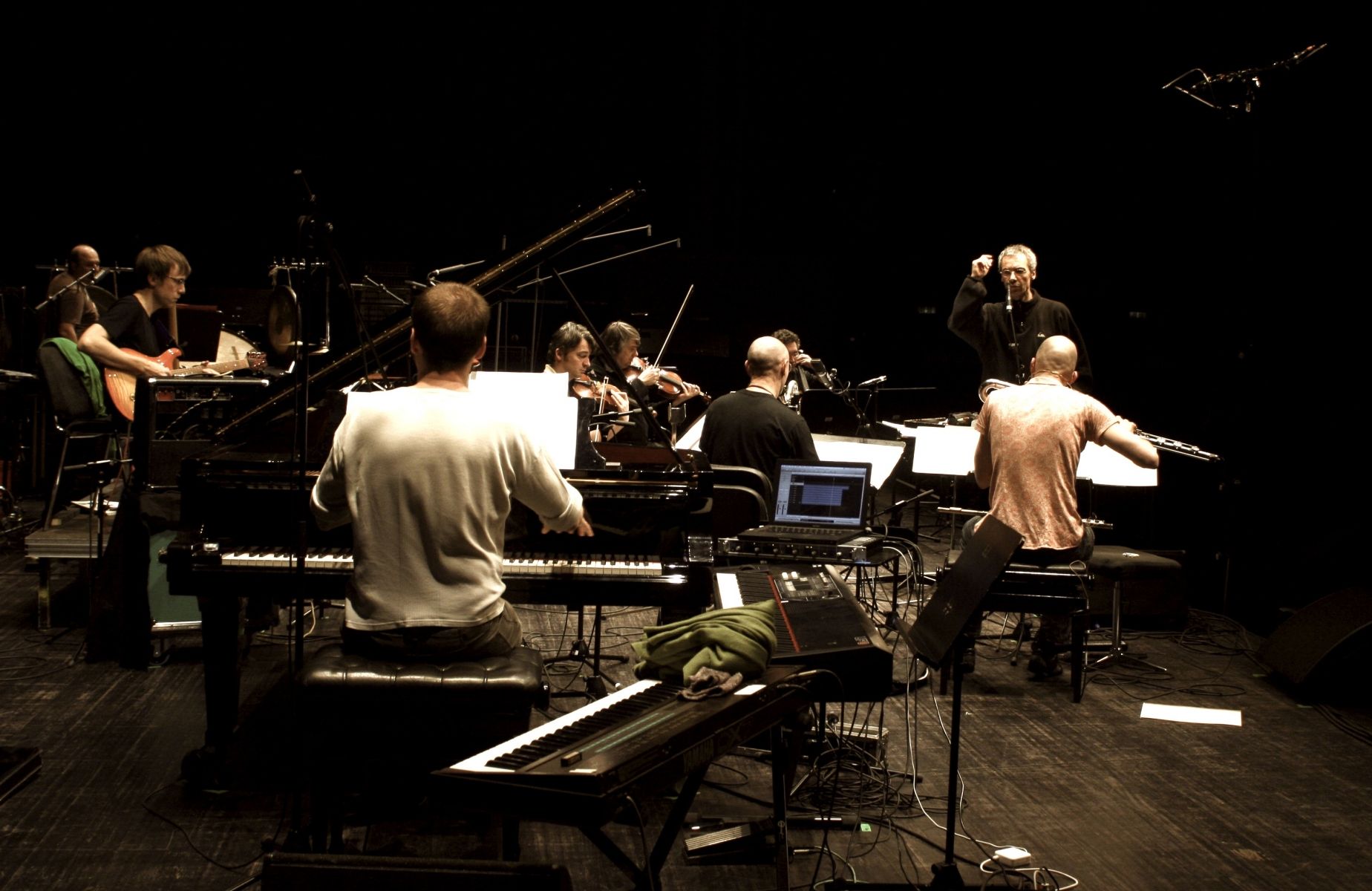
Liner notes from the Cyprès CD booklet, Professor Bad Trip
Professor Bad Trip and his lesson of the Thing
_‘Ever since I was born, I have been immersed in digitalised images, synthetic sounds, artefacts. Artificial, distorted, filtered – this is the nature of man today_’, says Fausto Romitelli, born in Milan in 1963.
At the age of 28, composer Fausto Romitelli moved to Paris to follow courses in computer music at the IRCAM. Here he studied ‘spectral’ techniques introduced by Gérard Grisey and Tristan Murail: the elaboration of sound ‘complexes’ fusing timbre and harmony; acoustic simulation of electronic sound; written ‘surreal’ models of acoustic phenomena were achieved by twisting, compressing and stretching the musical material.
Amid this huge construction site committed to the plasticity of sound, Romitelli soon realizes the possible connection with the worlds of alternative and psychedelic rock.
Rock music, however, with its energy, impurity and its impatient, anarchistic recourse to electronic artifices has overwhelmed many a composer. Fully rooted in its time and against its time, rock music carries an intensity of violence that seems irreconcilable with (serious) written music. What’s to be done? Whether one quotes it or parodies it, one still finds oneself between a rock and a hard place. One may prefer to remain indifferent; pretending that it is part of some commercial strategy, yet one knows this is not the case. Equipped with this knowledge of spectral techniques, inharmonic sound, frequential filtering and distortion of the sound spectrum, Romitelli broaches the question. Hence the only solution for him: cold-blooded participation in this madness while not compromising his métier. Without recourse to improvisation or simplification, he meticulously elaborates an instrumental style throughout his work, welcoming all the resources of ‘dirty’ sound, idiosyncratic _guitar-hero_ phrases and all harmonic mutations ranging from clarity to absolute distortion.
In the _Bad Trip_ cyclethat we present on this CD, his _‘obsessive, repetitive and visionary’_ poetics (in his own words) are firmly established. Here one can see Romitelli’s Manifesto, guided by the star of Henri Michaux. Inspired by the poet’s descriptions of the effects of mescaline, the music in _Bad Trip_ proceeds through flux and reflux. With gusts of increasingly dense and unstable waves, initial harmonic purity is followed by a prolonged ascent of dross and disorder.
In _Bad Trip_ the interior processes are invariably rooted in short and naïve ideas such as ‘complexes’ of slightly elusive melodic fragments, appealing and fragile harmonies, brief ornamentations exalted, glorified as sighs. Not having the time to unfold, the material is at once subjected to jolts. It repeats itself, but one realizes that it is mutant, infested by viruses: it becomes monstrous. The elements of the complex become hysterical, affected and develop into an expressive metastasis, each of its own will. The harmony becomes weighty, overloaded, the sound saturated, glissandi become magnified and cover the entire spectrum, the musical tempus contracts…the music of _Bad Trip_ never ‘develops’: it becomes _more grave_.
_‘Artificial, distorted, filtered’_ such is the delinquent nature of _Professor Bad Trip_’s Lessons, as estranged from melancholy as it is from mere enthusiasm for technology. The pioneers of electronic music easily conjured up the ‘infinite possibilities’ and ‘unprecedented resources’ of the art of ‘composing sound’. With _Bad Trip_, we have reached a point far beyond even waving this approach a gentle good-bye. As Eric Denut so subtly pointed out, with Romitelli, timbre is not used as an infinite resource’, but rather as a _mutilating element_ (1).
While the formal structure emerges through repeats, paraphrases and amplification in a more classical sense, the element of timbre corrupts the process by imposing improbable mutations _(abominable and indomitable countenance_)(2).
Fausto Romitelli uses the following paragraph from Henri Michaux’s _Light Through Darkness_ (_Connaissance par les gouffres_) as an epigraph to the score of _‘Professor Bad Trip’_:
A vast redistribution of sensitivity takes place, making everything bizarre, a continual complex redistribution of sensation. You sense less here, and more there. Here and there where? In dozens of ‘heres’ and dozens of ‘wheres’ that you didn’t know, that you didn’t recognise” (Henri Michaux, _Connaissance par les gouffres/Light Through Darkness_).
It is in the spirit of this ‘unrecognizable’ that the CD was played, recorded and mixed. Enjoy it.
Jean-Luc Plouvier
(English translation: George van Dam & Mike Lynch)
GALLERY
CAST & CREDITS
- Romitelli
- Georges-Elie Octors, Conductor