Introduction aux ténèbres (Raphaël Cendo, 2009)
Introduction aux ténèbres (Raphaël Cendo, 2009)
Raphaël Cendo: Introduction to Darkness
programme note by the composer
Written between 90 and 100 AD, the Apocalypse of John – Apocalypse meaning laying bare, removal of the veil or Revelation – prophesies an intermingling of events of the past, present and future. This literary style was adopted in the Old and New Testaments in particular (the apocryphal texts) by Daniel, Peter, Elijah, Moses etc….Written between 90 and 100 AD, the Apocalypse of John – Apocalypse meaning laying bare, removal of the veil or Revelation – prophesies an intermingling of events of the past, present and future. This literary style was adopted in the Old and New Testaments in particular (the apocryphal texts) by Daniel, Peter, Elijah, Moses etc….
The Apocalypse of John (The New Testament) is no exception to the rule when describing the end of the world and closes with the vision of the New Jerusalem (the Kingdom of God) which would replace all Kingdoms on earth, forever. The highly symbolic scriptures of the Apocalypse opened the way to several modes of interpretation. Notably: the idealist theory which considers the Apocalypse to be a struggle between good and evil; and the futuristic view which sees in this book a description of events to come, a prophecy. Contrary to general opinion, if there was indeed a Kingdom of the Beast – i.e. Satan, it was only to prepare the world for the arrival of the Kingdom of God.
The Apocalypse is the most controversial textual material in the Scriptures. It appeared at a time when religion was intimately linked to politics, and flashes through visions of pending disaster and descriptions of great cruelty. This text was initially a scripture that sought to help the Christian community through a period of great persecution and to predict the downfall of the Antichrist – a term describing “an impostor, a group or an organisation which, prior to the end of the world, would attempt to establish a religion opposed to that of Jesus Christ”. This would explain why this book circulated secretly and was at first written in a symbolic and even encrypted form of language. The Apocalypse describes not only the end of the world but also the whole history of humanity. The text also serves as a prophecy of the fall of Rome and the collapse of the persecutor, the Roman Empire, and the emergence of Christianity as its replacement.
The issue of the Christian Apocalypse refers to our own Apocalypse (but without any religious connotation), to that of our community as a whole, and also to the more intimate Apocalypse in our own lives. What veil do we want to lift from ourselves, what dark times await us, and what is the Empire that has to be destroyed today?
Introduction to Darkness is structured around three songs rendered in Latin from the 22 Revelations of the Apocalypse of St. John, without following the actual chronological order of the book. The piece opens and closes with a Prologue and an Epilogue. The Prologue and the Epilogue are to be heard in accordance with their original interpretation: “as a prelude to the speech or lyrics (introduction or preface) and to close the production (conclusion or end). These two sections carry within them traces of long-lost voice tones that resemble the floating debris of a language lost forever.
The first song – Revelation 8 – “there was silence in heaven about the space of half an hour”.
These are the seven trumpets of the angels announcing the Flood, hail and fire mixed with blood and the death of life on earth. The text, portraying a horrific vision with unprecedented violence, is dealt with in a musical manner, which goes against the overall context. The music is no more than an echo of a world that has vanished forever.
Second song – Revelation 4 – “Come up hither, and I will show you what will be hereafter”.
The absence of any chronology in the text is due to the fact that I wanted to place a description of the Kingdom of God in the middle of the song. This second song is a terrifying and daunting description of the Kingdom of Heaven – rather than a description of that of Satan. Here, we come across “four beasts, full of eyes before and behind” and the blinding lights flash across the general lexical theme of the song. The music focuses on very shrill sounds, the sole shining light in the entire piece.
Third Song – Revelation 13 – “Then I saw a Beast rise up out of the sea, having seven heads and ten horns, and upon his horns ten crowns, and upon his heads the name of blasphemy”.
The third song is a description of Satan's reign on earth. Incredibly inventive, here we come across “a Beast resembling a leopard, with feet like the feet of a bear, and a mouth as the mouth of a lion” or “a Beast that had two horns like a lamb, but speaking like a dragon”. This was a period when all things evil were worshipped, including blasphemy and the devil’s own number, 666.
--------
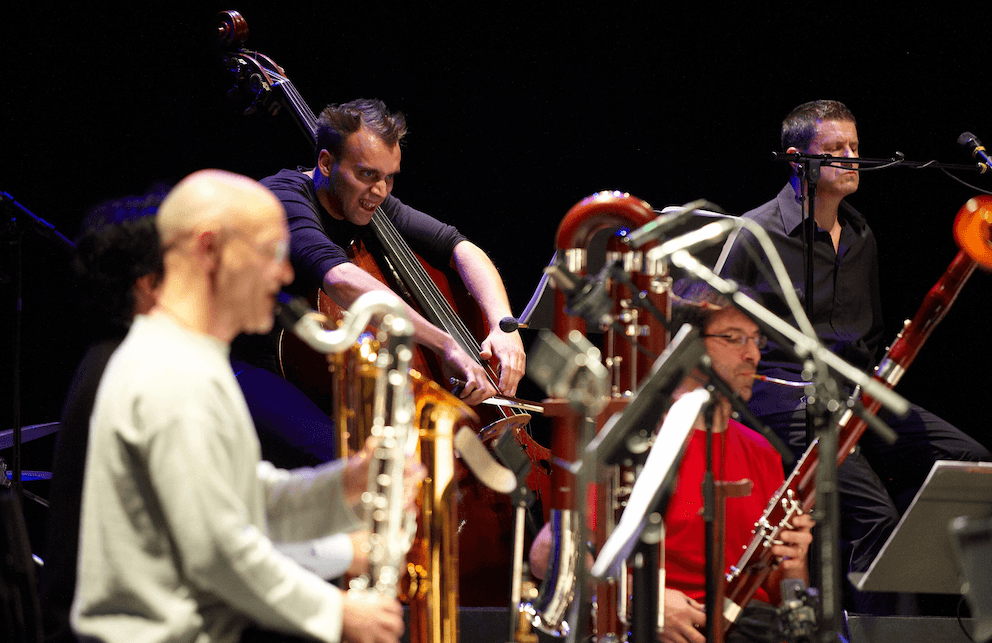
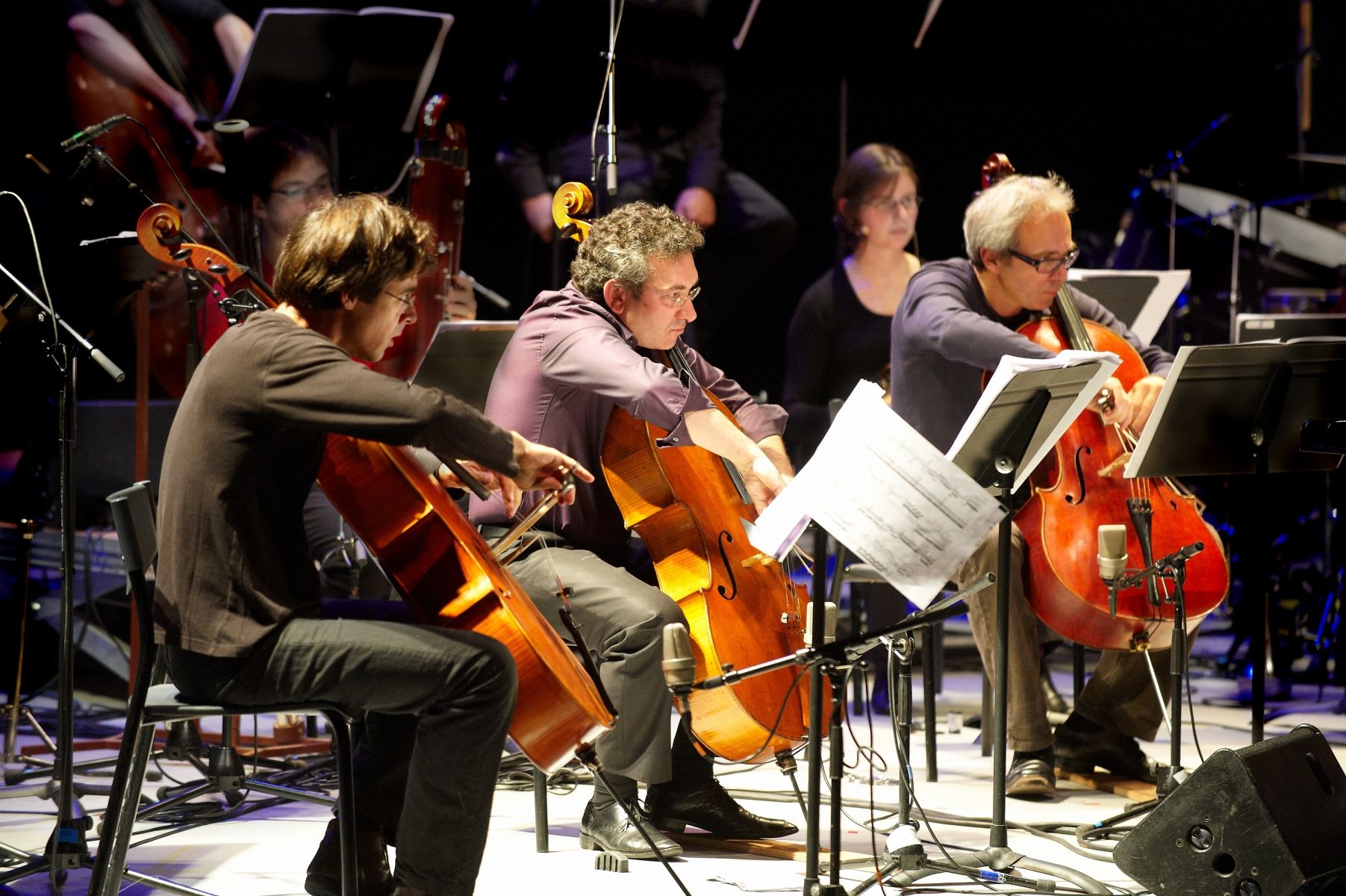
The musical display basically consists of the low register instruments. In this set, the double bass soloist has a very special position. Apart from the solo role, the soloist has a more enigmatic task that might be described as an unusual duet with the actual vocalist. Within the orchestra, the role of this soloist stands out from the rest of the group because of the very energetic virtuoso performance, the intense techniques displayed and the use of precise instrumental motions. In the second case, the double bass player accompanies the vocalist by way of a continuous dialogue. Here the role may be defined as the satanic part of the text, like a second interpretation of the voice. The language expressed by the double bass player in this example seeks to create harmony with the vocalist by keeping piece with the nuances and variations of the voice. This arrangement is essential to the piece, the double bass forming the link between the orchestra and the lyrics.
My writing of the script is focused on what I call the infra-saturated. As far as my other works are concerned, advocating a form of total saturation, with energy being the driving force, what stands out here is the suggestion of a world ravaged by excessive energy, where all that remains is a phantom relic of its former self. Infra-saturation represents a world where nothing remains but the distant passing of flames, a world made of ash, leaving a trail of immeasurable energy. This is a period of time haunted by past conflicts and plunged into endless nights. This was described very well by Georges Didi-Humberman when discussing the bomb dropped on Hiroshima (in “Spirit of Case Dismissed”: “Marked forever on the scale of time, that very precise form of pulverisation, that ash form of an object destroyed by fire, lies right on the boundary of two extreme states of things: on the one side, the massive flash that makes the whole sky explode and, on the other, the gargantuan greyness that smothered the whole earth. It is a fine thread that links the period of fire and the covering of ash.”
The concept of saturation carries within it the notion of excess and challenges acts of moderation. Overindulgence in sound and the overload of information pushed to the limit, open the way for new tracks in the formation of tone. Beyond saturation, but still falling within its influence, infra-saturation is nothing more than a reference to its own Darkness, the advent of a dark form of energy, a descent into a saturated state of hell.
I would like to thank the Ictus ensemble for its invaluable contribution to this project; Roman Bishoff for the research work that carried out together and also Gregory Beller. I also wish to thank all those people who have supported this project.
_Raphaël Cendo_
GALLERY
CAST & CREDITS
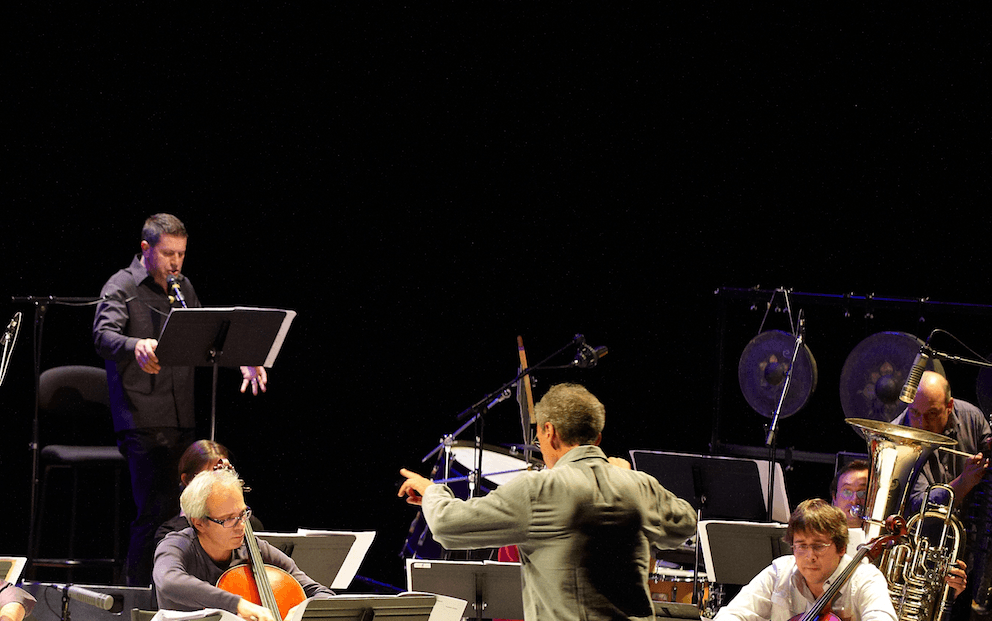
- Georges-Elie Octors, conductor
- Romain Bischoff, voice
- Nicolas Crosse, contrabass