Nerone (Clemens Gadenstätter)
Nerone (Clemens Gadenstätter)
about Nerone
With a lyre in his hand he sings of Rome as it burns. Although this scene probably never happened, it still shapes perception of a historical figure who is just as famous and notorious in the present day – Nero, the Roman Emperor from 54 to 68 AD. A far-sighted conqueror, Olympian and multi-talented artist on one hand, and a murderer, arsonist, antichrist and megalomaniac on the other. It is these very contrasts and discrepancies which emerge from the contradiction of the “sensitive monster” that make Nero so fascinating. The real subject as a hard-wearing screen that is projected onto – everyone has their “own” Nero.
Clemens Gadenstätter tackles the potential as well as the complications of this conflicting interpretation in his stage play Nerone. Nero here is both himself and his various representations – emperor and artist at the same time and in the same place. The subject and setting of Nerone is therefore the stage which does not just refer to the theatrical space. Instead, Gadenstätter extends the stage towards contemporary everyday perception and experience. Beyond the sphere of the representative “play”, it becomes an ambiguous space of action and drama, constantly fluctuating between authenticity and semblance and between the factual and narrative.
Existing simultaneously in various (social) spheres, roles and functions and adapting to these environments mimetically has long been part of the modern human condition. Meeting the challenge of this complete engagement requires a certain willingness to demonstrate a “split personality”. We are just as much real as virtual and act directly but equally so through media. In Nerone a historical figure becomes a symbol of this “art of metamorphosis”. Various constellations of a game of deception between identities are explored in four “dramatic acts”. Nero appears in various contexts in these scenes – as an actor playing the part of the emperor, as an Olympian who abuses the noble games for self-aggrandisement, as an observer of the Great Fire of Rome and as a statue of the petrified guardian of the Domus Aurea.
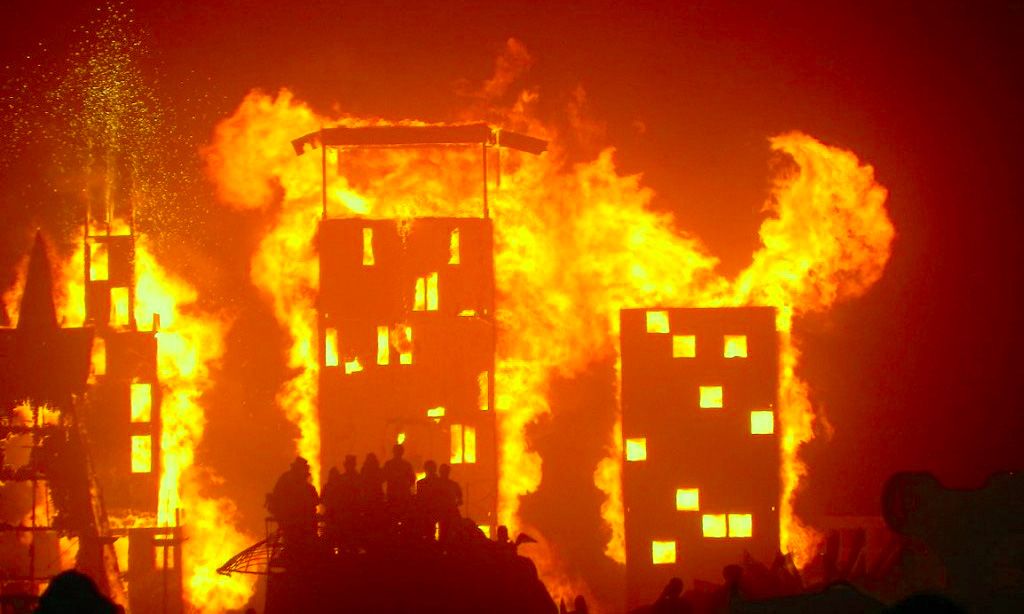
The fire scene in particular imbues the play with identity, reality and fiction which Clemens Gadenstätter allows to unfold in Nerone. The Great Fire of Rome is staged from different perspectives – Nero, who watches the burning city, Nero, who writes an epic poem about the Burning of Troy as an allegory for Rome ablaze and finally the experience of the actual fire by the Roman citizens. The scene therefore appears simultaneously in three versions – as an aesthetic object, as an allegory and as brutal reality.
Nerone is a piece that constantly touches upon borderlines. Nothing is clear from the outset or reducible to a specific meaning. In contrast, every action is always the representation of another. The play’s principal concept is that of a space that, on one hand, influences the action that takes place within it but, on the other, is also shaped by each of those actions. This interaction opens up a wide range of possibilities for working with different media – music, sound, language, text, narration, images and film. No element stands alone but is instead always part of an interaction.
In Nerone, Gadenstätter creates musical and theatrical situations in which he puts his aesthetic concept for illuminating the semantic qualities of music in contexts that are as multifaceted as it is possible to conceive. The audience is put under a spell of the most heterogeneous perceptions and challenged to continually adopt new positions. Nero is a fleeting fixed point. He conquers the audience and makes them a participant in his imponderable staging. “Nerone”, explains Clemens Gadenstätter, “is a means of presenting theatre in the theatre but at the same time the terrifying reality of our modern world.”
Four Dramatic Knots
1
Nero, an actor that mimes the Emperor
The audience acts like an audience, but is at the same time subject to the Emperor’s decisions – as well as those portrayed? (the projection?) as the real one. This scene deals with the inescapability and brutality of the mixture of representation and reality. What happens, when the border blurs between an action as expression of an existential necessity and one as a delusion of another, when effects of representation and those real actions are seen as equal?
2
The Olympic games, all of them won by Nero
Nero is not uneducated in the required disciplines, but he is in fact not an Olympian. Through corruption he creates a situation in which the ritual of contests are transformed into an “as-if”; a demonstration of real power and godlike insanity.
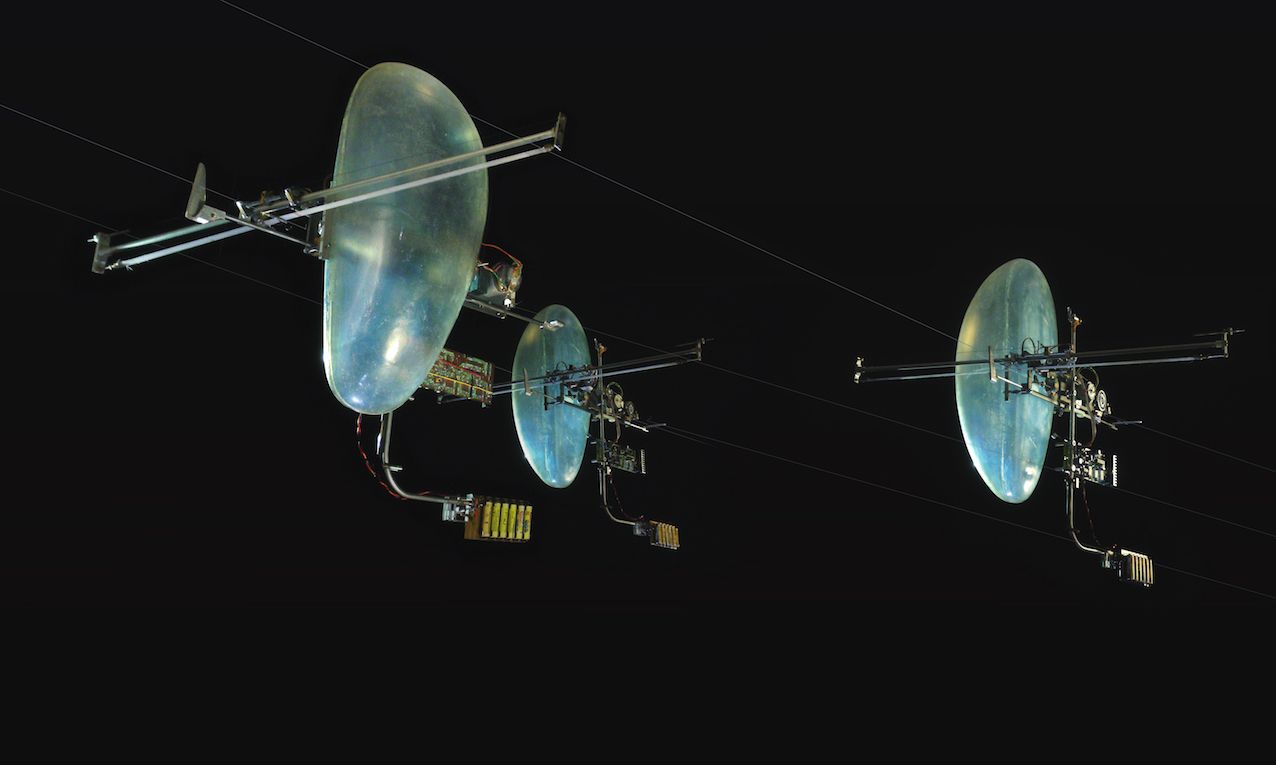
The sporting ritual, that was founded to strengthen the social and political framework is on the next level to where it is placed by the real power of Nero, “just/no better than a ritual”; the real, in the ritual captured fight (like a fly in amber) suddenly gets to the re-enactment of a competition following a script. Nero’s power is in this expression admitted in reality, but he holds himself up to ridicule by declaring it to a theatre audience. Representation is reduced to illustration. Within the imitation the holy ritual becomes a harlequinade in which a self-representing Nero kills real humans. In structural terms the competition will be between the “mechanical” musician and the musicians of the ensemble, always won by the mechanical one.
3
Rome burning
This is perverted by Nero into a play by singing his own epos of the fire of Troya while watching the burning city from afar. He correlates the representation given by the Illias of this event with this other one, the fire of Rome, through which he opens a space of total inauthenticity. In this space he sees the drama taking place for real in front of his eyes as “real fiction”: he staged this spectacle. Nero’s decisions concerning the re-building of the city after the fire make the simultaneous presence of both levels of reality clear: sophisticated fire precautions should shelter his “Domus Aurea” which will be the stage of his further plays and events, a scenery/decor in which he will continue to live on.
The fire of Rome will be staged from various perspectives at the same time: Nero watching the burning city, Nero singing the epos of Troy burning in the form of an allegory, the reality of the fire experienced by the Roman citizens. The scene will be simultaneously staged as an aesthetic object, an allegory and a brutal reality.
4
Nero’s “Domus Aurea”, which is planned as a theatre/playhouse
Here the parks are planned as “luna parks” for Roman citizens. A 40 metre high colossus in the centre illustrates him in “divine nudity”. The living environment becomes a stage. The multiple fractured aspect of space is emphasised here as an artistic object: the house as a space for different social spaces, for various uses (an emperor’s villa and luna park etc.) and as a pure aesthetic object. All qualitative aspects of spatiality are at the same time actual ones (Nero’s apartment and the centre of his power) as well as figurative ones (the staging of the actual one).
GALLERY