Interstices [with Amir ElSaffar]
Interstices [with Amir ElSaffar]
![Interstices [with Amir ElSaffar]](/api/strapi/uploads/amir_elsaffar2_d93fe691d0.jpg)
Preliminary words by Amir ElSaffar ...
The new work will be composed for oboe/English horn, clarinet/bass clarinet, violin, viola, cello, double bass, percussion/cimbalom, re-tuned piano, plus myself on trumpet and santoor.
The piece will utilize maqâm in polyphonic contexts, including harmonic structures, heterophony, and overlaying of melodies akin to counterpoint.
The harmonic and melodic elements will be microtonal, reaching beyond the limits of typical maqâm modulation practices toward new harmonies and microtonal resonances, often creating difference tones and pulsations.
Ornamentation - trills, portamenti, wavering of pitch - as well as a wide variety of timbres based on maqâm practices will be precisely notated, and intrinsic to the melodic architecture.
Rhythmically, the piece will alternate between free sections that have pulse but no discernible meter, sections that are rhythmically rigorous and layer repeating cycles of varying (but related) number, speed, and impulse.
Emphasis will be given to silences.
(ElSaffar, 2017)
A moving singer, jazz trumpeter and santur player (a kind of cymbalum of Iranian origin), Amir ElSaffar tries to find his way between writing and oral transmission. And we try to follow him! At the centre of his work are the learning of microtonal scales, the melodic use that the musician makes of them, and the affects that they express - the Arabic language uses the word maqâm to refer to these three questions, which are one and the same.
Confronted with the music of the maqâms (whose tradition crosses the Arab, Persian and Turkish worlds), the Western-trained musician is suddenly seized with a particular embarrassment; the slightest fatigue, the slightest doubt about himself, and there he is, feeling like a brute thrown into a porcelain world.
—It's all over, he said to himself in secret, it's all over with hitting the notes for what they are! And your dear extended techniques won't do a thing about it, smartass!
Total reset: from now on you must slow down the reading, free up time for quiet study, unfold the modes one after the other, let an infinitely modulated voice rise up, sculpting each intonation as if in the morning of the world. For the mode is mood: that of noon is not that of evening, the praise of being alive is not the complaint of love, etc.
An American of Iraqi origin, Amir ElSaffar spent his twenties studying maqâm. Then he went through a lot of Western music: classical music and jazz - especially jazz (listen to his band Rivers of Sound). On the trumpet as well as on vocals, the subtility of his phrasing would make a rock cry.
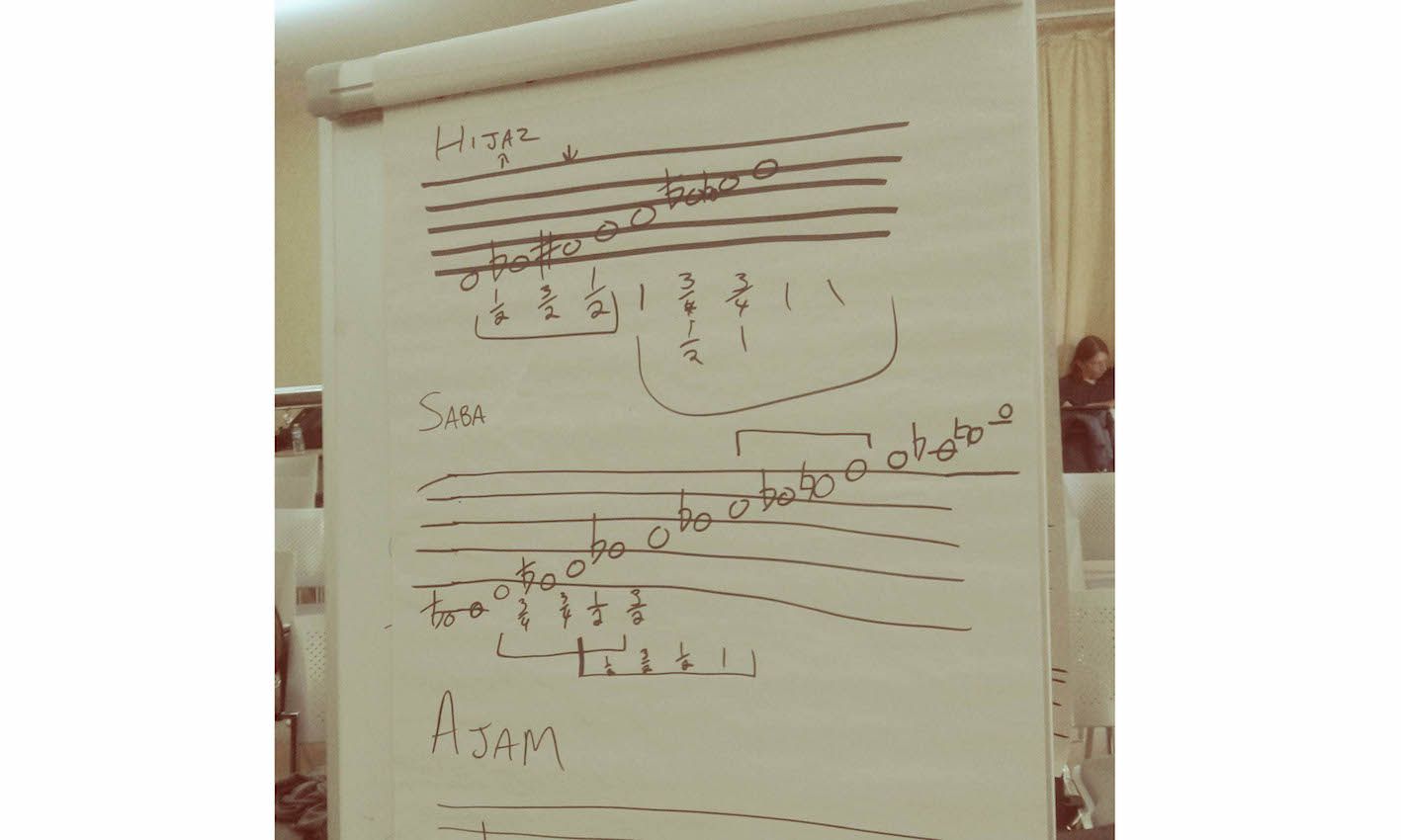
ElSaffar gave us the pleasure of a seminar at Royaumont (1), of a few maqâm lessons, of a bunch of pieces written on paper, which give pride of place to the work of polyrhythms. No doubt there is no automatic interface between the worlds, no massive transcoding surface; yet common breaths emerge... the gentle exaltation of endless work,... the promise of a possible universality: interstices.
JLP
(1) Thanks to Royaumont, thanks to Fabrizio Cassol.
GALLERY
CAST & CREDITS
WORKS
Amir ElSaffar trumpet, santur, voice
Dirk Descheemaeker clarinets
Sylvain Devaux oboe, English horn
Tom De Cock percussion, cimbalom
Jean-Luc Plouvier microtonal piano
Igor Semenoff violin
Jeroen Robbrecht viola
Geert De Bièvre cello
Géry Cambier double bass
Alexandre Fostier sound
Amir ElSaffar : INTERSTICES
Resonance
SegahWorld
Chord
HD Blues
Bayat Pent
19
Production Fondation Royaumont.
Coproduction Ictus, Alwan Foundation-Alwan for the Arts.
With the support of Sacem and Fondation Camargo/The Jerome Foundation.
With patronage of KPMG and Groupe ADP.
The Amir ElSaffar's work has been commissioned by Fondation Royaumont.