SOLDAT (Stravinsky | Aperghis)
SOLDAT (Stravinsky | Aperghis)
1
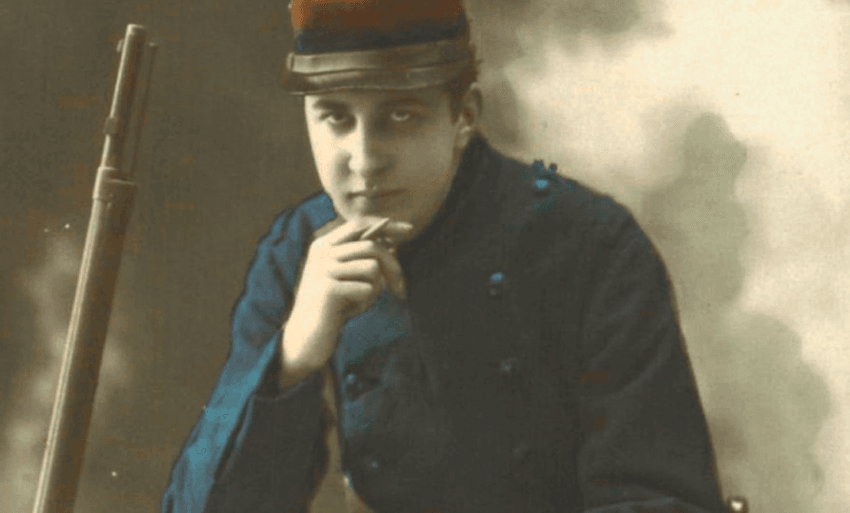
We had long heard tell of whole worlds that had vanished, of empires sunk without a trace, gone down with all their men and all their machines into the unexplorable depths of the centuries, with their gods and their laws, their academies and their sciences pure and applied, their grammars and their dictionaries, their Classics, their Romantics, and their Symbolists, their critics and the critics of their critics. . . We were aware that the visible earth is made of ashes, and that ashes signify something. Through the obscure depths of history we could make out the phantoms of great ships laden with riches and intellect; we could not count them. But the disasters that had sent them down were, after all, none of our affair.
Elam, Ninevah, Babylon were but beautiful vague names, and the total ruin of those worlds had as little significance for us as their very existence. But France, England, Russia... these too would be beautiful names. _Lusitania_ too, is a beautiful name. And we see now that the abyss of history is deep enough to hold us all. We are aware that a civilization has the same fragility as a life. The circumstances that could send the works of Keats and Baudelaire to join the works of Menander are no longer inconceivable; they are in the newspapers. That is not all. The searing lesson is more complete still. It was not enough for our generation to learn from its own experience how the most beautiful things and the most ancient, the most formidable and the best ordered, can perish _by accident_; in the realm of thought, feeling, and common sense, we witnessed extraordinary phenomena: paradox suddenly become fact, and obvious fact brutally believed.
[...] With our own eyes, we have seen conscientious labor, the most solid learning, the most serious discipline and application adapted to appalling ends.
So many horrors could not have been possible without so many virtues. Doubtless, much science was needed to kill so many, to waste so much property, annihilate so many cities in so short a time; but _moral qualities_ in like number were also needed.
Are Knowledge and Duty, then, suspect?
(Paul Valery, The crisis of the mind, 1919)
2
Le soldat Innconnu (Georges Aperghis)
Standing on smoking rubble, a man recalls the myth of the Tower of Babel and seems to become aware of a parallel between the vanity of that venture and the pointlessness of the cataclysm from which he has emerged more as a spectre than as a living being. In a little less than 30 minutes Georges Aperghis, with his dense, precise and taut composition where quarter tones rule, leads us through a musical allegory of the absurdity of war as the ultimate negation of humanity.
_F. Lajournade-Bosc_
3
A Soldier's Tale
"Before World War I, Stravinsky shocked the world with a series of three ballets written for Parisian premieres, the most avant garde and famous of the set being _The Rite of Spring_. One might wonder how five years later, at the close of the war, Stravinsky’s musical style had metamorphosed from that of grandiose violence to satiric and cutting simplicity. That’s not to say that _A Soldier’s Tale_ is simplistic or without complexity but rather that a newfound diatonic parody of popular, religious, and folk tunes dominates the sound of his writing in a completely unexpected way.
The reasons for the drastically new sound of _Soldier’s Tale_ could partly be described as economic, as both the war and Russian Revolution cut off the composer from access to funds and resources from home, “and I found myself, so to speak, face to face with nothing.” In his autobiography of 1934, Stravinsky goes on to describe the assembling of the work: “So we worked at our task with great zest, reminding ourselves frequently of the modest means at our disposal to carry it to completion. I knew only too well that so far as the music was concerned I should have to be content with a very small orchestra.”
It is perhaps ironic to think that the choice of a dry, acerbic instrumentation for _A Soldier's Tale_ was a decision not simply driven by artistic ideals but mainly by forces beyond the composer’s control. Here was Stravinsky concocting a new revolution, not a monumental one as witnessed in his earlier ballet scores, but one where the musical ingredients of music we know (Tango, Ragtime, Lutheran hymnody) are mutated and displaced as are the facial features of a Picasso portrait. [...]
_Jason Hardink_
for Nova Chamber Music Series, Salt Lake. >Read more...
4
Georges Aperghis : Interview
by Francine Lajournade-Bosc, February 2014
A small group of musicians, a solo voice, it rather appears that with this _Unknown Soldier_ you were working with material familiar to you…
Yes, but it's my first for an ensemble and male voice. My previous compositions for comparable set-ups were for female voices (1). As for the scoring, there is a clear reference to Stravinsky's The Soldier's Tale, even though to achieve my balance between the instruments I have added a piano, two cellos and a second clarinet. I always feel safer with two clarinets and two cellos. I feel more at home, .... and less chez Igor.
*What is this Unknown Soldier all about?*
It opens with a solitary man who has just emerged from the rubble and the horrors of battle, and who is almost surprised to find himself alive. But perhaps he isn't alive, since he is the unknown soldier. He is assailed by conflicting emotions: he weeps, he laughs, he screams. Is he a survivor? Is this a dream? Is all this really happening? We don't know. Perhaps after all it is nothing but a circus. When horror reaches such extremes, things descend into circus and into the burlesque because otherwise it would be impossible to bear. Louis-Ferdinand Céline captured very well the absurdity and the circus-like nature of war. And especially that war. So this soldier should be seen as an allegory, a character coming from the music rather than from the theatre. He only exists in music, after all.
So your soldier is undergoing a traumatic experience ?
Absolutely. He makes me think of those TV images of earthquake survivors, or battle casualties. We see a man on the rubble, screaming his essentialist despair. But what about all those still beneath the rubble who may be dead, alive, or living their last? The soldier tells his story, and gradually we hear this swarming sound created by the ensemble, coming from all those who we cannot hear. The instruments do not speak. We can therefore assume that, for those others, it is even worse. They have been through the same experience but no longer have the means to put it into words. It reminds me of one of Hitchcock's films (2) in which the main character survives a car accident but is completely paralysed, and thought to be dead. But suddenly a tear can be seen running down his cheek, and only then do we realise that he is still alive; this is the aspect which I have tried to convey in my music: the instruments are still alive, but unlike with the soldier who has the means to speak forth, you have to listen closely to hear their story.
Right, so is this « allegorical soldier » to whom you refer represented only by the solo voice, or is he also present in the instrumental sections?
The soldier is represented solely by the solo voice. Throughout the piece, the ensemble accompanies him, but sometimes joins the opposition. Not in a military sense, rather as an outside force which is there to remind him of what it is precisely that is driving him insane. At times, the ensemble falls silent and leaves the soldier to confront himself. Now and then one or two instruments detach themselves from the group, like the leader of the Chorus, to follow the soldier ... or to contradict him.
You chose to use a text by Franz Kafka to illustrate the traumatic experiences of the soldier. Why?
The Kafka text, Babel, calls Europe to my mind. I have kept only a few sentences from the text, but it was enough to ring a bell for the people who will hear the piece. The text is very short, effective and as always with Kafka succinct and unadorned. I love the density of his writing. The text gives the working basis for the second aspect of this Unknown Soldier. In the midst of his lassitude he suddenly recollects a story from before his disaster. The Tower of Babel had to be built. But the more building work progressed, the more jealousies were aroused; some sections were perceived as better or more attractive than others. Wars and fighting ensued to lay hands on the best parts of the tower. Over the generations, fighting alternated with periods of peace during which everyone worked on improving the tower. Then wars would again break out and in the end there came a generation which had forgotten why they were building a tower at all. Ultimately thousands died without really knowing why, and that is precisely what happened in WW1. This perception was with me throughout the period when I was writing the Unknown Soldier : how many people, be it in the name of the International, of Anarchism, or like this footsoldier in the name of the nation, went to war with a song in their heart merely to be blasted to oblivion. Each time it is a different reason or cause, but the result is ineluctably the same. There are whole generations of the young who have gone to war singing but who today fill the graveyards of the world.
When you speak of the tower which generated jealousies, one has the impression that you are speaking of the building of Europe. Was your intent political?
I don't know, but we know so little about this building of Europe... of course, I do hope that there won't be another war, even though it can be argued that there already is a kind of North-South war going on which for now is merely mental and financial. When you consider how some countries predominate, you wonder where this business with rich countries and poor is leading us. There are some echoes of all that in this work, but there are no attempts to lecture anyone. Here we just have a soldier who has gone mad and who remembers the Tower of Babel. They say to him: « If you go off to fight, that is what you will be defending ». He went, he saw what he saw and he remained unknown. The story is as simple or as absurd as that.
This soldier isn't entirely unknown, since it appears that from the outset he had a name attached, which was that of Lionel Peintre, the baritone. Did you think of him immediately to perform the part?
Yes, certainly. I wrote the Jactations (3) for him several years back, for unaccompanied voice. The fact that he could actually sing it was something of a triumph. When I started to write the Unknown Soldier, knowing that it would be Lionel to sing was a great reassurance to me. It is hard to discuss Lionel because he comes complete. And as such he is talented and intelligent enough for me to trust him. He has sung pieces which seemed quite impossible, but sing them he did, and successfully. So if Lionel were to say to me: « I've done my best, but that really is beyond me », I know that there's no point in pursuing that route. Speaking of him purely as a performer, I also trust him not to stray towards styles that do not interest me, like psychological or sentimental interpretations. He always adheres very much to the classic in his style of singing. And apart from all the colours his voice possesses, he understands the text. Right from the word go.
The way you are talking gives the impression that no-one but Lionel Peintre would be capable of singing this part...
No, of course that's not true. Jactations has been performed by singers in various countries and very well too. Perhaps it is the score itself which imposes this style of singing. One can't really get away from it because there simply isn't the time. I have structured the form so strictly that the performer has no time to do what in any case I detest: adding theatricality, sentiments, or who knows what else. In the Unknown Soldier I have managed to ensure that the physical requirements of singing rule out any further interpretation. By that I mean that when the singer has to appear tired or out of breath, he really is so. The work has been written in such a way as to ensure that the singer is genuinely out of breath at that moment. So it would be pointless, and in any case impossible, to do impressions of « tiredness » or « breathlessness » as well. This was already the case in Récitations (4). When one doesn't breathe for a while the voice sounds quite different from when one is breathing normally. Really, nothing needs to be added, one merely has to do as instructed.
*Could you describe to us what happened on the first morning when you sat down at your desk to write the Unknown Soldier_ ?**
It can't really be said that there is ever a « first morning » as such. You begin by assembling purely musical material which in itself is fairly anodyne. Polyphonic phrases, forms, short snatches of music… like fragments assembled for the instruments and for the voices. And then there comes a moment when all these fragments together seem to have something to say. Sometimes you are wrong, and it turns out that they have little in common. In that case, you start again. And then sometimes that missing catalytic particle appears which brings the whole piece together. I suppose it's a sort of « corner fragment » similar to a « cornerstone » in architecture. But you can be sure of one thing, composing is anything but a linear process.
When you began on the _Soldier_, you had just finished writing _Situations_ (5) for the Klangforum Wien, also a piece for instrumental ensemble but with no solo voice part. Do you think the fact that you moved on to the Soldier immediately after can have influenced it?
Most certainly, but I couldn't tell you how or to what extent. What I do know is that I found it very difficult to come back to words. It was very hard to revert to a character who had to be invented from scratch, who was not a given. The idea behind _Situations_ was to paint a portrait – imaginary, mental or musical – of the Klangforum musicians. You can't really speak of them as characters, since they are real, and I can speak to them and observe them. They are there. Whereas for the _Soldier_ it was necessary to invent someone. The whole process is reversed.
You have recently gone back to composing for full orchestra (6), something you had not done for a long while. Is it very different from composing for small ensembles?
It is utterly different. What you need to consider for a full orchestra is completely different from that for an ensemble. It is rather like having a large highly sophisticated factory full of people who are able to work on technical details, as against a small craftsman's workshop, where everything is made by hand, I can't put it better than that. With a small ensemble, everything is closer to the human scale than with the great orchestral machine.
When you compose for full orchestra you make no use whatever of microtonality, although it is one of your trademarks. Why?
My whole system is based on microtonality, but I haven't dared use it for a full orchestra. I didn't want to make things more difficult. Keeping a grip on quarter tones with a full orchestra to me seems a rather unlikely prospect. Of course, supposing that my works were being played 50 years from now and that orchestras had been able to do as much work on my _Quatre Etudes_ as on say a Brahms symphony, it might perhaps become possible to deal with mictrotonality. But I'm after an immediate result. What I want is to be able to hear the work in my lifetime.
Are you saying that you compose for yourself?
My precise reason for composing is in order to hear sounds that I've never heard before. But it doesn't always work. If I hear one of my compositions and get the impression that I've heard it somewhere before, I say to myself : « Well old boy, that didn't quite work! » To some extent it can indeed be said that I write for myself, but I share with those who are going to receive the music. It is a way of sending them missives in the hope that I'll get a reply. Even if the first missive is, indeed, always intended for oneself.
___
(1) eg La Nuit en tête (2000), Dark Side (2003), Contretemps (2006), Shot in the Dark (2010), all written for soprano or mezzo soprano and ensemble.
(2) « Breakdown », in « Alfred Hitchcock presents », Season 1 Episode 7, 1955
(3) Quatorze Jactations for baritone (2001), Editions Durand
(4) Récitations , for solo female voice, 1978, Editions Durand
(5) Situations, for instrumental ensemble, 2012, Editions Durand
(6) Quatre Etudes for orchestra, 2011, Editions Durand
GALLERY