RIHM / BASELITZ (strijktrio)
RIHM / BASELITZ (strijktrio)
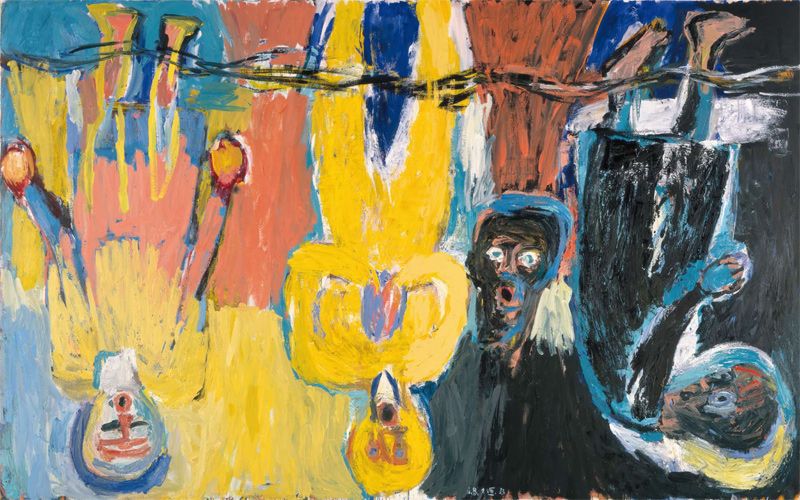
In 1981, there appeared in Germany a manifesto that was to have a certain success, calling for a New Simplicity in music. It was co-signed by Wolfgang Rihm, a name that would soon become synonymous with a revival of lyricism in contemporary music to the point where there was even talk of “neo-romanticism.” An expression that immediately calls for clarification: very aware of the past, Rihm revisits it with a fierce and powerful passion that is never melancholic. His dark and eruptive energy, his oblique references to Schumann or Mahler, his fascination with Antonin Artaud, the angular simplicity of his works, the apparently improvised progress of his forms and the over-abundance of ideas (more than 400 works to date!) must all be seen within a kind of raw and fragmented romanticism that makes Wolfgang Rihm something of a musical brother to Georg Baselitz.
“I write my music with my nerve ends, not with a pen”, declared the composer.
Also: “Music is a series of signs erected across time. I seek in music not so much a logical link as a vibration between the signs.”
Written in 1977, when Rihm was 25, his ‘Musik für drei Streicher’ (Music for Three Strings) is the first masterpiece by an artist of precocious maturity. At times frenetic, at times hieratic, this 55-minute piece, in seven movements, irresistibly conjures up metaphors of rocks, minerals and molten lava.
“I have the notion of great block of music inside me. Each composition is both a part of this block and a precise physiognomy to be sculpted. To see who I am I must cut into my own flesh, open myself up, ask a mirror what it sees,” wrote Wolfgang Rihm. One could imagine it was Artaud speaking.
GALLERY