FUMIYO IKEDA & JEAN-LUC FAFCHAMPS : INTERVIEW (NL, ENG, FR)
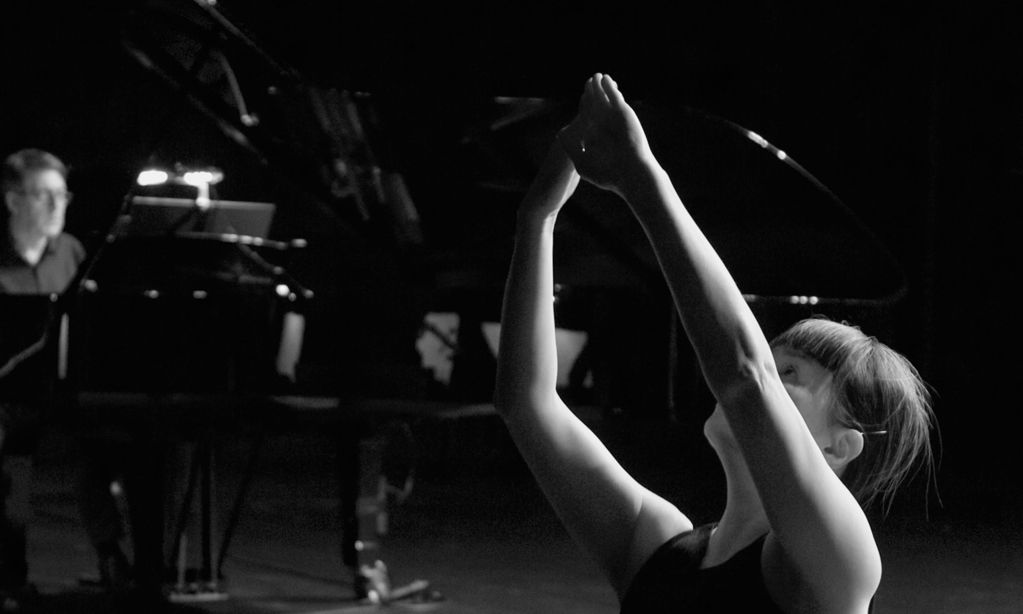
ABOUT 'Piano and string quartet'
FUMIYO IKEDA: One day, quite out of the blue, a Canadian string quartet (the Bozzini Quartet) contacted me and suggested I would think about creating a choreography for Morton Feldman’s Piano and String Quartet. For me, this suggestion was something of a godsend and a mission at the same time. I promised them I’d take a listen.
Oddly enough, in the beginning I found it impossible to listen to this music, to concentrate on it for more than five minutes at a time. I had to keep on stopping the disc to go off and do something else! I was indeed coming out of a period in which I had been studying Bach’s music, in which everything was much clearer: A, B, C, repeat, A’, variation; a whole discipline and enjoyment of musical analysis, with the score to hand, that I had learnt at Rosas. With Morton Feldman’s music, I kept on feeling a sense of promise and expectation, the feeling that something was going to happen, and that that something wouldn’t come about in the end, or that things never work out how you expect, and it was making me terribly nervous — and then I would stop listening. But I didn’t change my mind, I had decided to keep on going until the end of the disc; I would go so far as to say that my anxiety made the work more and more interesting.
It was in this frame of mind that I went to see my musician friends at Ictus. I needed help with listening to it, even if deep down I knew that I had already said “yes” to the work.
Which dimension of the work did you say “yes” to?
F. I.: I have been working on memory for ten years - conscious and subconscious memory. That’s exactly what I could feel in the work of Morton Feldman: his music always makes you want to say: “Oh yes, I know that, I recognise this moment!” To the point that you think you can anticipate the music, guess what’s coming next. But no, in reality... at the precise moment when your memory thinks it has got a hold on things, everything has changed slightly. The aspect has been transformed. And you end up feeling...
... disorientated.
JEAN-LUC FAFCHAMPS: Disorientated, or perhaps: disarmed! I lecture in musical analysis and I am very well aware that that is a way of intellectually “arming” ourselves when studying music. But it doesn’t work like that with Morton Feldman.
Can you tell me about your own encounter with this music?
J-L F.: I graduated from the Conservatoire, at 23 years of age, after having studied a lot of pieces, and always pieces with lots of notes — amongst others I had developed quite a passion for Liszt! A concert producer gave me the opportunity to play Feldman, who I only knew by name at the time. It was supposed to take place two or three years before his death, we spoke of this composer as someone who prevented you from going round in circles, like a sort of antithesis of what was going on in Europe at the time. I went to a music shop to take a look at Feldman’s scores to try to get an idea of the length of the individual works, in quite a simplistic fashion I have to confess, according to the number of pages: I needed one that was 25 minutes long, and one of the scores seemed to correspond to this volume because it was the same thickness as Liszt’s Sonata. Only it turned out to be a one and a half hours long! I played it in concert and it was a revelation. I found out that it’s possible to play music without constantly having to wait and see what’s coming next...
Music that varies constantly is nothing new...
J-L F.: That’s true, but Feldman doesn’t compose “variations” which take you somewhere, all the while retaining a suggestion of their model. What he composes could be better described as “variants”. Mini-variant after mini-variant, small difference after small difference ... wandering around aimlessly, if I can put it like that.
And so, Fumiyo, you contacted Fafchamps in the hope of making yourself a choreographic aid from his musical analysis resources?
F. I: I basically contacted Fafchamps to be sure that I could stop using the analytical tool! While listening to Feldman’s music I feel like I’m looking out to sea, I get the same sensations: I’m sure that it’ll stay there, but that’s about all I can be sure of. I know that it’ll change, that there will be a high and a low tide, but I’ve no clue when they will occur. This is why I didn’t want to work measure by measure, motif by motif. I didn’t start out from a small unit. I looked into constructing a very long sentence, a fifteen-minute-long one. This sentence is made up of 135 words.
What is a choreographic “word”?
F. I.: It can come from a part of the body. I have a vocabulary of approximately 60 words which come from the body: an elbow, a finger, a lip, the act of breathing. And then a vocabulary of the same volume from animals: the crocodile, for example. By dancing my sentence five times I just about cover the duration of the music.
So you don’t worry about the music in detail? You’ve separated dance and music?
F. I.: No! I could say that this sentence has become the ear with which I am now, finally, listening to the music. When it comes down to it, I had to choreograph this music in order to really get it. Now I can hear all the differences. I can even hear words. And when, later on, you re-see the same gestures, they are no longer the same.
J-L F.: She couldn’t get the analytical tool to work, so she found her own one!
F. I.: I then divided the sentence up into 9 segments, so that I could vary the order in which it was played. This idea came naturally: you obviously had to recombine, apply an action to the structure. It was interesting, but I felt like I was having fun all on my own. All the more so seeing as I had used a random machine to combine my 135 words — because I believe that machines often get it right when you want to produce the most beautiful combinations — and I could have reproduced this randomness in real time during performances. But what would have been the point? What’s the point of adding iPads? The intensity of the sea changes, but waves are still waves. I gave up on that idea.
J-L F.: In this specific context the repetition creates more “difference” than variation. Feldman was a great collector of Persian carpets. You have to visualise the Iranian workers who make the carpets in their kitchens, identically reproducing their knots and patterns— but in reality, you’ll never find two the same. There is a very Proustian nostalgia which comes from all of that, the impression that every gesture is already a memory, even the first time around.
Feldman, a carpet collector, you said, but also a big fan of modern art...
J-L F.: Feldman would have undoubtedly become a painter if his eyes hadn’t been so bad. Imagine the scene, and him too, his eyes glued to the score, with his spidery scrawl. It’s an amazing paradox: this music conceived on such a large scale, which opens up such large spaces, was laboriously written by a man with his face glued to the page.
You mention the large scale... Is the duration of the music governed by a huge general curve?
F.I.: Yes, and that’s why I decided not to stay exactly in my place, as a sixth musician. There’s a change in place which, in spite of everything, takes a dramaturgy of the music into account. This music always evokes a sort of distance. And I too, might step away from the musicians. For a very long time the piano acts like a kind of release mechanism. The quartet takes second place. But things are inversed. There is a very moving point at which it starts again, when the quartet seems to have found a driving force, a dancing rhythm...
J-L F.: ... quite similar to a five-beat rhythm… The piano slows down a bit, the end seems to be indefinitely postponed and the string quartet takes centre stage. There is an interesting point that relates to the extent to which the pianist has to hold down the pedal from the very beginning till the very end of the work - he never lets you hear the silence. There is always some kind of resonance. The quartet can stop and give people the chance to listen to the silence. The quartet has this power to punctuate sound and silence, which the piano does not have access to.
Interview conducted by Jean-Luc Plouvier
>The page "Piano & String Quartet"