(but if a look should) April me
(but if a look should) April me
(text by Claire Diez)
_Celebration, whether sacred or profane, a herald of the attack, joy or grief, a memory left behind for the present or the continuation of the past, conjuring up a future or exorcising it, in all of its forms, celebration holds death at bay. And like a tribe of apes that assembles in the face of immanent danger, the tribe of people unite and thus are strengthened, demonstrating this extra power with a collective rhythm that it in turn reinforces still more. In one rhythm, always the same, all beating upon the drum that is the Earth, all are dance and word and song. But repetition promotes uniformity, uniformity monotony. See now the one among the people who senses the danger. In his rhythm, something incites him; in this same rhythm, the grand defiance of the law of a dying world incites him, inspires him, to re-launch the celebration via the stimulation of the surprise..._
_Fernand Schirren, in Le rythme primordial et souverain, coll. « La Pensée du Mouvement », Published by Contredanse._
A cruel and lavish celebration for a shotgun wedding. A dejected young man and young woman are offered up in the interest of the community, boisterous gaiety to silence the grief of the bridal couple. Wedding song, battlefield. _Les Noces_ by Stravinsky was performed for the first time in Paris in 1923 by Serge Diaghilev and Les Ballets Russes, and since then often danced, often honoured. In exile, Stravinsky thinks back on the folk songs of his native Russia and on the unbridled intoxication of the country weddings. He dreams up a player piano accompaniment to underscore the masquerade. In exile, Bronislava Nijinska invents choreography, inspired by belaboured, stylised icons and archaic mosaics. Like Kandinski (On the spiritual in Art) she anticipates the fact that the more abstract and pure these dance forms are, the more she breathes the expressive power of the primitive.
April 2002. Anne Teresa De Keersmaeker performs Noces, her first ballet. It is the cornerstone of her new creation, which she calls _(but if a look should) April me_ , referring to a poem by ee cummings. _April me_ also contains echoes of _The Waste Land_ by T.S. Eliot: _‘April is the cruellest month, breeding / Lilacs out of the dead land, mixing / Memory and desire, stirring / Dull roots with spring rain.’_ Together with Thierry De Mey, composer and film maker, the choreographer forges other music around _Noces_ like fine woven branches. This ethnic music stems from times when daily life was still determined by the rhythm of the chant passed down by the elders. They smell of the beauty of the remote corners of the world: the polyphonic singing of women in the rice fields of the Po-plain, about the beloved that goes off to war (Sento il fischio del vapore), the lament from Radjastan, where one mourns for the absent beloved at night, unless it is the silent God with respect to the grief of those that wait (Rosiya), to the concluding, lonely and dreamy dipping rhyme from South India, where a child amuses itself melodically by looking at the stars with much pleasure (Chukke Hakki).
Above these emotional and popular reminiscences, space is filled in with percussion pieces, ‘the drum of the earth’, unbridled pulsation, the compelling metronome, cosmic radiation…, but also with silence, honed with subdued pressure. The creation of _Fiançailles_, a new composition by Thierry De Mey acts as a prelude to _Noces_, colourfully interpreted by Dmitri Pokrovski. He was the director of the Moscow vocal ensemble and rewrote the piano score from Stravinsky on a Macintosh, thus creating a rhythmic pattern like a machine that launches the song on a rail and nothing can slow it down. The singers travelled through the south and west of Russia to absorb the unbridled power and the gravelly timbres of Slavonic folklore.
“_Fiançailles_,” explains Thierry De Mey, “originated in the spirit of the stages of transformation of the Yi King in different percussion movements (water, soil, thunder, wind, sea…), the compositional principles integrate but also the negate the pulsation present in _April me_: computer-based beats, a combination of speeds, what submerged sound form can ascend from the imprint of a rhythm? How can the incursion of a rhythmic event disrupt the regular beat and bring about a leap or a movement? And so on.” Constructions snipped by choreography from life, whether faithful or not, synchronised or shifted in one or more directions… And between the six percussionists from Ictus and the thirteen dancers from Rosas a formal alchemy comes into being with spiral formed motifs and other delayed braids. The more abstract and pure the form, the more primitively the movement stands out, thought Nijinska, whose intuition for the essential Anne Teresa admires.
Thus _April me_ clearly is an important phase in the work of Anne Teresa De Keersmaeker. After _Rain_, which developed out of the transformed vocabulary of In real time, comes _April me_ from the roots of _Small hands_ (duo by the choreographer with Cynthia Loemij). “The vocabulary has a different flavour this time, so it seems to me,” says the choreographer. “It is more lyric, less angular and softer. I like long lines, extensions, yet they continue to bump into cracks and twists, sleep walking between elegance and clumsiness. Like _Bartók/Aantekeningen_, _Noces_ reminds one of the baroque, the beat of feet, being anchored in the ground. The ballet also demands choreographic teamwork, but for me it remains a sum of individuals, of counterpoints that must be synchronised. _Noces_ also reminds one of a certain kind of emotional theatre, character theatre. It is my first ballet and I would like to take as my point of departure the purest formalism in order to evolve to the theatrical.”
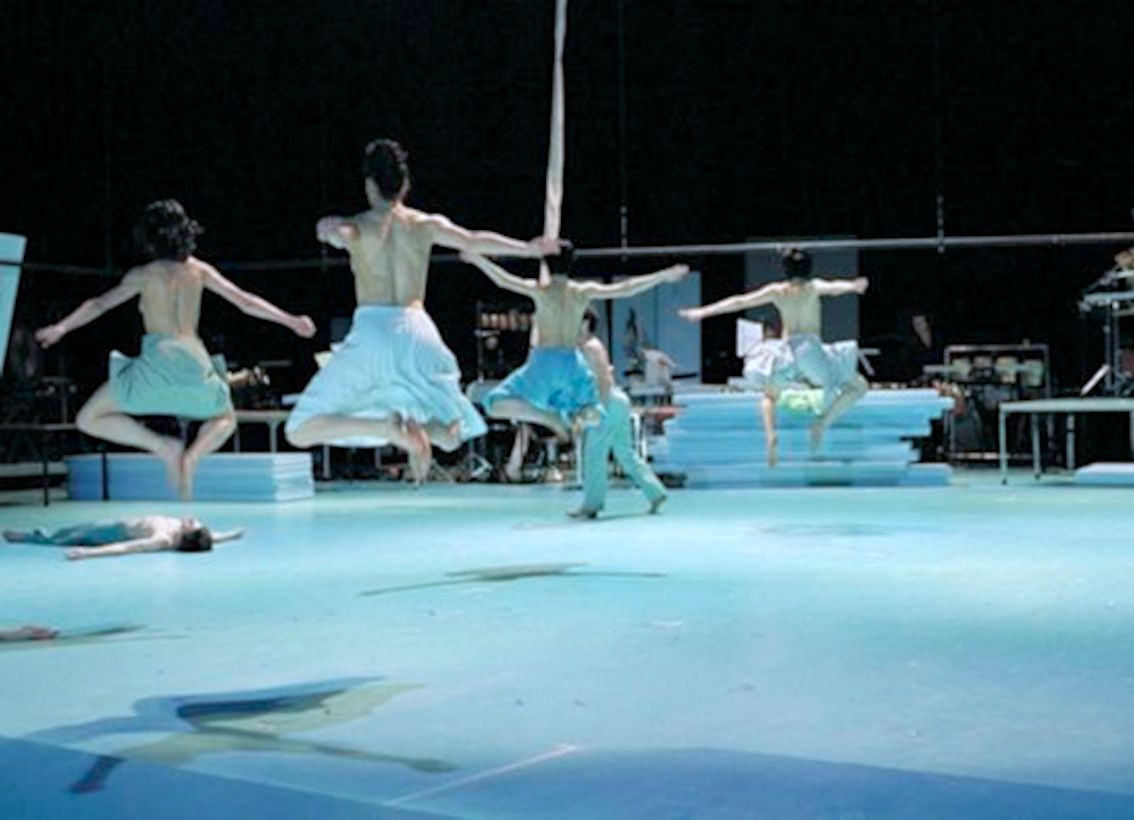
This time the scene is painted clear blue, a heaven fallen from the firmament, a roof that has collapsed to the ground, a chaos of rubble. Against this azure, we see the scarlet _Noces_, before changing into the golden brown reflections of an amber coloured loneliness. The air is palpable, as if you must first cut through it in order to dance into it. Time that suspends movement, surprises or quickens must be suppressed. “We have danced at an average speed for too long,” says the choreographer. “In Stravinsky’s score, the complexity of the accompaniment contrasts with the monotony of the love song. The Profane and the Sacred compete continuously, until transcendence is victorious. Thus, the union of beloved ones becomes more spiritual than physical.” The fire of this wedding then also raises questions: does the meeting of two essences bring about a blending together, a splitting up or a doubling at the human level… The only reaction is the voice of a child that is happy to see the stars.
Claire Diez
GALLERY
CAST & CREDITS
WORKS
- Anne Teresa De Keersmaeker,
- Jan Versweyveld, Set & light design
- Geert Peymen, Assistance
- Inge Büscher, Costumes
- Anne-Catherine Kunz, Assisted by
- Renaud Person, Copiist
- Alexandre Fostier, Sound
- Caroline Wagner, Assistance
- Alioch Van der Avoort, Assistance electronics
- Pascale Gigon, Rehearsal director
- Anne Van Aerschot, Assistance Artistic Production
- Luc Galle, Technical director
- Patrick Martens, Production manager
- Kristof Van Dijck, Lighting
- Frank Vandezande, Lighting
- Daniëlle Maes, Coaching sign language
Rosas : Beniamin Boar, Marta Coronado, Alix Eynaudi, Jordi Galí, Fumiyo Ikeda, Cynthia Loemij, Ursula Robb, Taka Shamoto, Igor Shyshko, Clinton Stringer, Julia Sugranyes, Rosalba Torres, Jakub Truszkowski
Popular Italian music and popular and sacred music from India
Thierry De Mey: Les Fiançailles: Water, Earth, Mountain (Wind)
Iannis Xenakis: Peau (Pleïades)
Igor Stravinsky: Les Noces
Thierry De Mey: Silence must be! (for solo conductor)
Gérard Grisey: Stèle
W.A. Mozart: Le Nozze di Figaro
Morton Feldman: King of Denmark