Chin, Schöllhorn, Ligeti in deSIngel (press review)
press
De Standaard, February 4th, 2002, Maarten Beirens
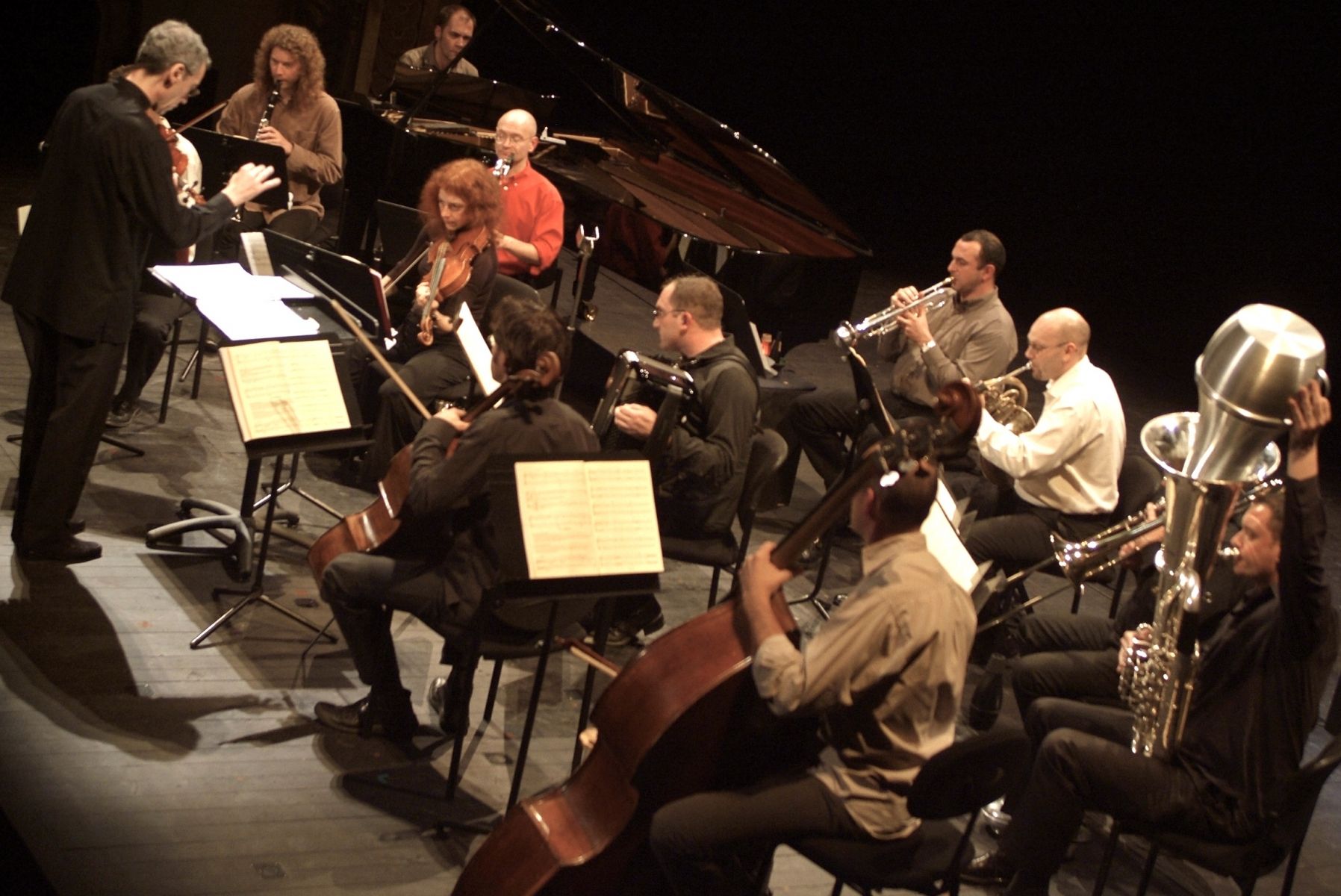
Ictus presents sparkling cocktail
One of the most agreeable aspects of contemporary music is the variety of what is written. This makes it possible to combine pieces that are in themselves very different but which together yield an interesting and colourful mix, as in this delightful concert by Ictus.
One can of course find points of contact between these works: the absurd touch in the pieces by Unsuk Chin and Johannes Schöllhorn, the sound exploration by György Ligeti and Jonathan Harvey, and of course the fact that the oldest composer in the programme (Ligeti) was the teacher of the youngest (Chin). But each of the works chosen had its own identity and character and set personal accents, and this gave the concert an added value on top of the exemplary performance by Ictus.
The Korean Unsuk Chin was able to charm immediately with his _Akrostichon - Wortspiele_ for soprano and ensemble. The highly varied mixture of timbres reveals Ligeti’s influence and in the last part the elegant arabesques are reminiscent of Claude Vivier, though Chin gives it his own pronounced character. It is above all excellently written, and the way the rarefied heights of the soprano Donatienne Michel-Dansac blended with the fine details of timbre that Ictus provided gave the music an added impact. Jonathan Harvey’s _Advaya_, an Ictus classic, also goes a long way in its detailed timbre, but the balance between the electronics and the cello was not always at its best and I have also heard the cellist François Deppe play this piece much more impressively than on this occasion, when the great span of the music was a little uneven.
Johannes Schöllhorn’s _Anamorphoses_ was a very witty work, containing a Bach parody in which the _Kunst der Fuge_ was replaced by Francis Ponge’s absurd text _L’art de la figue_. The nice thing is that this piece has no pretensions whatever, but is very well made and, what is more, has a cheerful iconoclastic feel. Ligeti’s _Kammerkonzert_ also has this sort of contrary, smirking sense of humour, but the imagination with which Ligeti here combines his ideas is so powerful that even after more than thirty years the _Kammerkonzert_ still stands as one of the strongest works from the second half of the twentieth century.
The conductor Georges-Elie Octors led the Ictus musicians faultlessly through Ligeti’s treacherous score, yielding an inspiring performance.