Pneuma (25th Anniversary Edition)
Pneuma (25th Anniversary Edition)
This is how the story went:
I.
In 1994, 25 years ago, we were 20 or 30. Gathered around Georges-Elie Octors and his calm, reassuring, dancing silhouette (oh, he could get the telephone directory to dance…). And things were dancing along just fine!
II.
Musically speaking, we witnessed the turn of the millennium, bearing the full brunt of the crisis of this great artistic discipline, born in the 12th century, and known as “western classical music” – music that is written. The crisis was not so much about its decline in popularity as about the question of writing itself: what should be written, what should not, where and how should it be written, and why? Nothing was clear any longer.
III.
At the same time, we admired the endurance and wealth of experimental music, of jazz, pop or electro, and the never-ending excitement they provoked.
IV.
Beautiful books are always written in a kind of foreign language, as Proust used to say. So, we tried it all: being a big band, a mini orchestra, a rock group, good chamber musicians, a collective of performers… our identity eluded us.
V.
We kept our chins up. We had many friends who both stimulated and protected us: De Keersmaeker, Gypens, De Mey, Romitelli, Vandekeybus, Le Pladec and many others. As their friends and sometimes pupils, in our turn we have had pupils, and daughters, and sons
VI.
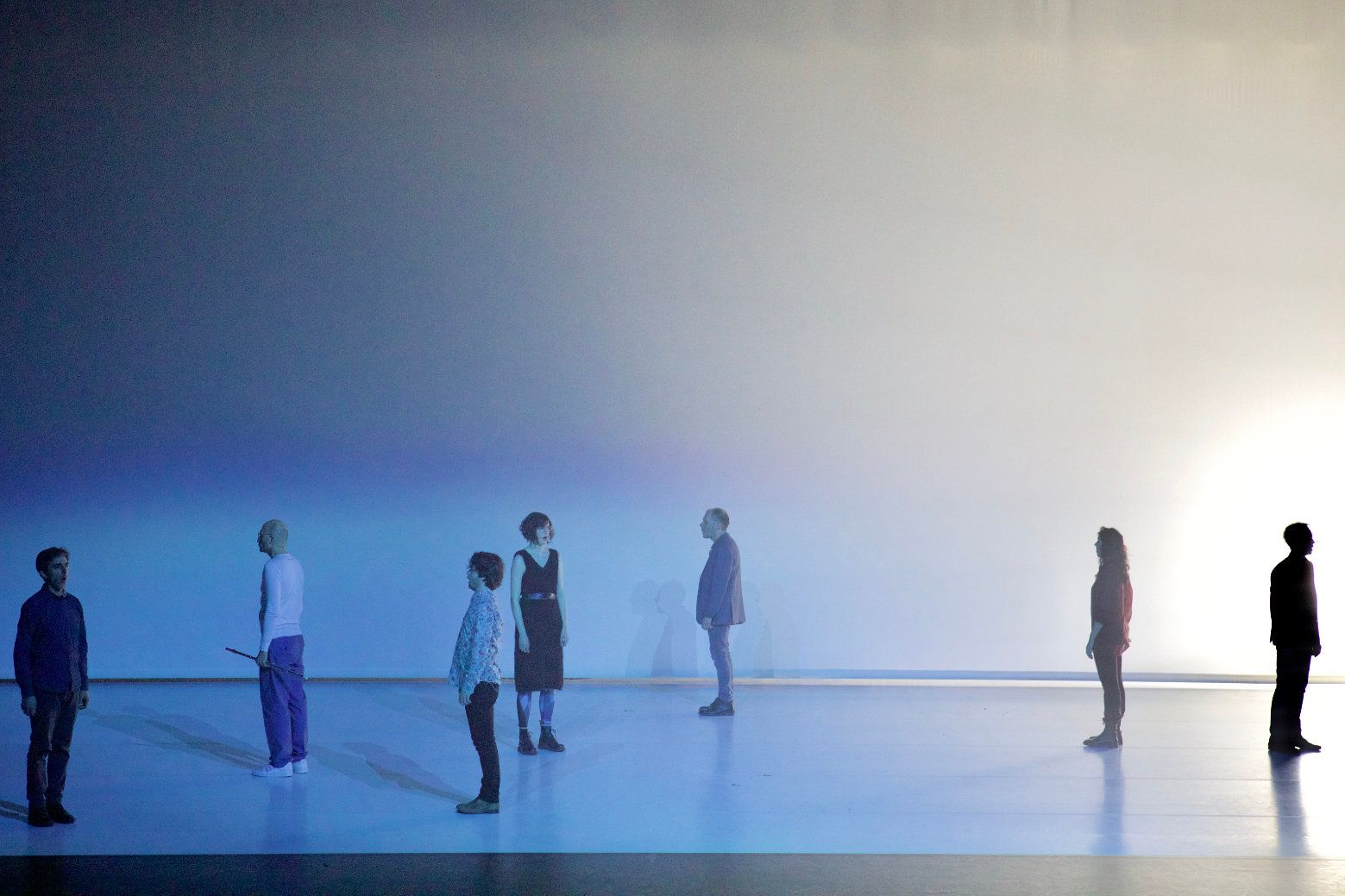
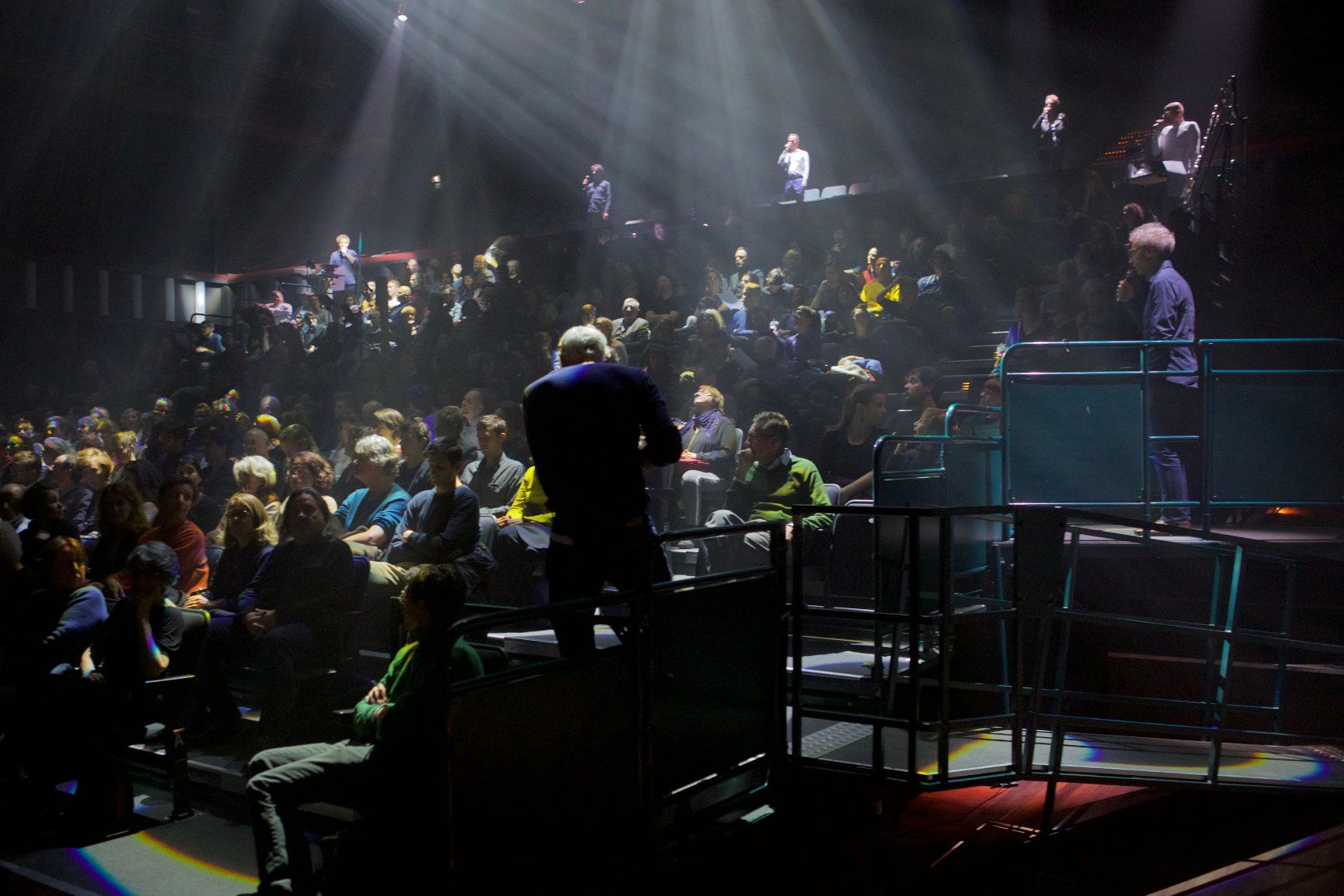
And here we are this evening. Welcome to our anniversary party! We'll share our breath with yours, if that’s OK. According to some, scholars may have written in certain treatises that such is the highest ritual of love – on certain occasions, at certain times, in certain tribes. And we have forgotten the names of the scholars, their treatises, and the tribes — but not the gestures …
ICTUS
IN TWO WORDS
We have 25 candles to blow out at the Kaaitheater in Brussels,
so we’re blowing strong!
We will sing our love for breath and the winds
In an unedited, brand new version of Michael Schmid’s BreathCore:
Pneumatic choir, a respiration’s polyphony...
— and with electronic artist Raphaël Henard as a special guest.
Sylvie Mélis (who worked with Rodrigo García, Luis Garay and Maud Le Pladec, among others), will compose a creation of light.
ABOUT THE WORKS
Michael Schmid: Breathcore #1 “Riviera Blues”, 2019, premiere
Michael Schmid: Breathcore #2 “Tenebrae”, 2019, premiere
« Performers let their breath resonate and create a field of blurred respiratory noisescapes. Their individual breath signatures interact, barely detectable, creating an atmosphere of diluted presences. BREATHCORE gathers a group of people to explore modes of collectivity through the practice of breathing. Breath is generic and contains a wide spectrum of characteristics - tactile, communicational, sonic. [...] » (Michael Schmid. Complete text on our site, HERE)
Fausto Romitelli: Seascape, for Paetzold recorder and digital reverb, 1994
« Flux, reflux; inspiration, expiration: the regular articulation of the tide, or of the breath, defines a distant, timeless sonoric landscape which is progressively subjected to a process of distortion, contraction, asymmetrisation and fragmentation up to the point that it explodes into different registers, from the extremely low to the extremely high. Exploiting the different extinction times of the sound in the extreme registers of the instrument I have sought to produce the illusion of superimposition and simultaneity. Seascape involves the use of amplification and reverberation but not of any electronic treatment of the sound. »
(Fausto Romitelli, Programme note, Ricordi Ed.)
Note: 'Paetzold recorder' is a double bass recorder (blockflute).
LINK to Youtube
Raphaël Hénard: Untitled Block, 2019, premiere
Raphaël Hénard: New Work, 2019, premiere
BIO: « Since graduating from the Fémis in 2012, composer Raphaël Hénard has performed at Centre Pompidou, and Palais de Tokyo, Paris. As a member of electronic music duo 'Plapla Pinky', signed with Japanese label Sonore, his work tours to festivals worldwide including: Villette Sonique, Paris; Siestes électroniques du Quai Branly, Paris; Nuits Sonores, Lyon; Sonar festival, Barcelona; Dans Dakar, Stockholm; Todays Art, Den Haag / Brussels; Club Metro, Kyoto… »
Link : the site of Villa Arson, Nice
Ashley Fure: Shiver Lung, for septet and electronics, 2016
« Shiver Lung presents material extracted from a large-scale immersive installation opera called The Force of Things: An Opera for Objects. A ring of subwoofers encircle the audience, projecting soundwaves too low to hear until performers slide the flesh of their hands across each palpitating surface, pulling the soundwaves into the realm of the audible. »
(Ashley Fure,Programme note)
Kaj Duncan David: 4c0st1ctr1g3r, for MIDI percussion pad, 2015
BIO: Kaj Duncan David (°1988) is active somewhere between contemporary composition, electroacoustic music and audiovisual performance. Light as a totally integrated musical voice plays a central role in much of his work [...] He explores the possibility of a point where interrelated visual and sonic materials become a single musical gestalt.
(Kaj Duncan David, website)
Karlheinz Stockhausen: Mikrophonie I, for tamtam, microphones and filters, 1966
« In 1964, Stockhausen acquired a 5-foot Paiste tam-tam (gong) which was first used in performances of MOMENTE, where it was struck, caressed, scratched and scraped in various ways with various drumsticks, mallets and screwdrivers. After installing it in his garden, he noticed that he could get additional sounds from it using metal keys and stones. Eventually, he had his studio engineer from in the house record his actions out in the garden as he rubbed and hit the tam-tam, manipulating a microphone to capture sounds at different distances. The recording engineer also randomly manipulated the frequency bandwidth and gain, all without hearing what Stockhausen was doing outside. After returning inside they listened back and realized they had discovered a new sound world. »
(Robert Maconie, Other Planets; The music of Karlheinz Stockhausen, 2005)
Pauline Oliveros: Drifting Depths, for harmonium and electronics, 2008, (intermission), initially composed for tenor harmonica and electronics. Arrangement: Michael Schmid
« When I was sixteen, my accordion teacher taught me to hear combination tones. The accordion is particularly able to produce them if you squeeze hard enough. From that time, I wished for a way to eliminate the funda- mental tones so I could listen only to the combination tones. When I was thirty-two [in 1964], I began to set signal generators beyond the range of hearing and to make electronic music from amplified combination tones. I felt like a witch capturing sounds from a nether realm. »
(Pauline Oliveros quoted by Martha Mockus, Sounding Out; Pauline Oliveros and lesbian musicality, 2007)
« After I had been studying with him for two years, Schonberg said, In order to write music, you must have a feeling for harmony. I explained to him that I had no feeling for harmony. He then said that I would always encounter an obstacle, that it would be as though I came to a wall through which I could not pass. I said, In that case I will devote my life to beating my head against that wall. »
(John Cage, Indeterminancy, 1958)
« Through Pauline Oliveros and Deep Listening I finally know what harmony is…It’s about the pleasure of making music. »
(John Cage, Interview, 1989)
Sylvie Mélis: Light solo, so ist mein Herz", 2019
ENG Light solo / So ist mein Herz: 35 mm cinema projector, scratched black primer film and scratched words projected on empty stand + text on gobo for muted light, 24 seconds duration in loop.
NL Light solo / So ist mein Herz : 35 mm filmprojector, geschraapte zwarte filmstrook, bekraste woorden geprojecteerd op een lege tribune + tekst op gobo voor gedempt licht, 24 seconden lang, in loop
FR Light solo / So ist mein Herz : projecteur cinéma 35 mm, pellicule d'amorce noire éraflée et mots griffés projetés sur gradin vide + texte sur gobo pour lumière asservie en sourdine, durée 24 secondes en boucle.
(Sylvie Mélis, 2019)
Links to a recent Mélis' work [UR]Licht, HERE or THERE
Istvan Matuz: The Glizz, for solo flute, 1974 (original title: Studium 1/974)
« Flutist and composer István Matuz is the pioneer of the prepared flute. Born in 1947, he grew up in Nagykőrös, Hungary, under the communist regime’s new educational system. Matuz’s extensive studies led him to believe that acoustics should be an important part of a flutist’s education. He believed that flutists should use the knowledge of acoustics to understand their instrument completely, including basic acoustic concepts of vibrations, difference tones, and the overtone system. »
(Stacey Lee Russell, The Prepared Flute: A Survey of its History,Techniques, and Repertoire, 2016)
Addendum: You too, learn [circular breathing](https://www.youtube.com/watch?v=J-LMiZHWdbU)! ^^
Jürg Frey: String Quartet n°2, 1998
« Here Frey uses extended techniques to create a very quiet, soft, almost noteless grey soundworld within which brief passages of bowed sound exist for two or three seconds, each interspersed with a second or two of silence, but again with the sounds used gradually shifting across time. This is hauntingly beautiful music. The playing resembles an ethereal vocal ensemble more than it does a string quartet. » (Richard Pinnell, Blog, 2007)
« Material can be anonymous. Consider, for example, the middle voices in medieval hymn books: unadorned, not artful, a simple handiwork, a leisurely alternation of single notes. It might be a scale, or, beyond music, the stones of a wall, not artfully stacked, but simply and properly, the formal idea being nothing other than that of a wall. »
(Jürg Frey, [Liner notes for the Bozzini Quartet CD](https://boomkat.com/products/string-quartets-87a03178-4179-4cf7-9de2-6edabf8b4fe1), Wandelweiser records, 2018)
GALLERY
CAST & CREDITS
WORKS
Michael Schmid
Breathcore #1 “Riviera Blues”
2019, premiere
Fausto Romitelli
Seascape
for Paetzold recorder and digital reverb, 1994
Raphaël Hénard
Untitled Block
2019, premiere
Ashley Fure
Shiver Lung
for septet and electronics, 2016
Kaj Duncan David
4c0st1ctr1g3r
for MIDI percussion pad, 2015
Karlheinz Stockhausen
Mikrophonie I
for tamtam, microphones and filters, 1966
Pauline Oliveros
Drifting Depths
for harmonium and electronics, 2008
(intermission)
Sylvie Mélis
Light solo, so ist mein Herz
2019
Raphaël Hénard
New Work
2019, premiere
Istvan Matuz
The Glizz
for solo flute, 1974
Michael Schmid
Breathcore #2 “Tenebrae”
2019, premiere
Jürg Frey
String Quartet No.2
1998